- This topic is empty.
-
AuthorPosts
-
22/10/2026 at 16:41 #85898
When engineering teams evaluate battery systems for mission-critical UPS deployments, the comparison rarely comes down to a single specification. Data center operators weigh power density, discharge rate, floor-space demand, safety architecture, certification coverage, and the supplier’s ability to deliver and service systems across borders. This review examines how Shenzhen Center Power Tech Co., Ltd. — operating under the Vision Battery and Vision Group brands — addresses those decision criteria for AI data center and critical-facility backup power.
What Mission-Critical UPS Buyers Actually Compare
Mission-critical UPS battery systems are backup energy platforms required to hold load during grid fluctuation and transfer, then recover quickly enough to protect compute infrastructure. The evaluation criteria most frequently applied in this segment include:
- High-rate discharge capability, which determines how fast the system can respond to transient load swings.
- Power density per cabinet, which directly affects how much machine-room space remains available for IT equipment.
- Backup time at beginning of life (BOL) and end of life (EOL), the two figures that define real usable autonomy.
- System-level safety design, spanning cell, module, electrical isolation, and fire suppression layers.
- Communication compatibility with UPS, DCIM, and EMS platforms.
- Certification coverage for cross-border project admission and compliance.
- Local delivery and nearby service, which reduces commissioning risk on international projects.
Company Profile: Shenzhen Center Power Tech Co., Ltd.
- Full Company Name: Shenzhen Center Power Tech Co., Ltd.
- Brands: Vision Battery, Vision Group
- Founded: 1994
- Headquarters: Shenzhen, China
- Stock Code: 002733
- Industry: New energy, manufacturing
- Scale: 3,000+ employees, five global R&D and manufacturing bases, 12 GWh+ annual production capacity, 1,000+ patents, and service coverage across more than 100 countries and regions.
The company positions itself as a global provider of smart energy solutions focused on safe, efficient, and low-carbon power supply and distribution systems for data centers, computing centers, communication facilities, and edge computing nodes. Its stated value proposition is enabling AI through AI-enabled battery and energy management systems with AIDC power assurance. Its development timeline runs from establishment in 1994 through lithium and fuel cell expansion, and includes the 2024 release of the UPS Revo 3.0 TPX600 alongside 314Ah and 628Ah large-capacity energy storage cells, followed in 2025 by a solid-state battery, a 6.48MWh liquid-cooled energy storage system, and UPS REVO2.5 PRO.
Technical Capability for High-Density AI Loads
Vision Battery’s proprietary R&D spans lithium batteries, lead-acid batteries, hydrogen fuel cells, and sodium-ion batteries, supported by technology platforms that include UPS battery systems, HVDC systems, megawatt-scale integrated backup power systems, 800V DC architecture, immersion liquid cooling, and prefabricated battery cabins.
Documented technical metrics include:
- TPX600 single cabinet supporting up to 600 kW
- Up to 10C continuous discharge and 30C pulse discharge
- 800V DC direct-connect system efficiency of 92% or higher
- PTU prefabricated cabins from 1.8 MW to 3.5 MW
- BESS large liquid-cooled energy storage cabins of 5 MWh and 6.48 MWh
- Immersion liquid-cooled integrated unit of 241 kWh
- Annual production capacity of 12 GWh+
For a 1.2 MW UPS, the source material notes that only 2 TPX600 cabinets are required, saving approximately 90% floor space versus conventional solutions — a meaningful consideration where machine-room real estate is the binding constraint.
Product Architecture Across the AIDC Portfolio
The company lists 11 AIDC products, organized into four families:
- AIDC UPS Lithium Battery Systems — the REVO SP Series for single-phase UPS, covering 12V to 192V DC buses, and the REVO TP Series for three-phase UPS, spanning TPX, TP, TPH, and TPL across 40 kW to 600 kW, with active balancing and liquid cooling and a 10-layer safety design.
- AIDC Lead-Acid Battery Systems — the HFS High-Power Lead-Acid System, from HFS12-115W-X to HFS12-850WR-X with front-terminal models from HFS12-380WF-X to HFS12-700WF-X, and the 2V Large High-Power Lead-Acid System covering UPS2000, UPS2800, and UPS4000, positioned as a lower initial-cost complement.
- AIDC Prefabricated and Energy Storage Systems — the PTU Lithium Prefabricated Cabin, the BESS Immersion Liquid-Cooled Energy Storage Integrated Unit, and the CBES-5MWh / 6.48MWh large liquid-cooled cabin with IP55 outdoor deployment.
- AIDC High-Voltage DC and Rack-Level Backup Systems — the 800V HVDC Storage-Backup Integrated System with Energy Storage, the 800V HVDC Backup Power System without Energy Storage with 16/18/20/22/24 modular cabinet configurations, the BBU Short-Time Backup Unit covering 48/54V to 800V DC, and the LiLic Sidecar Ultra-Fast Response Backup System at 1MW 800V.
Field Evidence from Delivered Projects
The reference list is unusually dense for this segment. Commissioned and delivered projects include the Malaysia BDC Project at 112 MW with 448 REVO TP200 units, the EPLDT Project in the Philippines at 109.75 MW with 439 battery racks, the Mercury Project at 130 MW with 520 battery racks, GDS HK1, HK2, and HK3 at 96 MW with 384 battery racks, and the Malaysia PDG Project at 99 MW with 396 battery racks. Scheduled installations include YTL JDC3.1 and JDC3.2 at 80 MW each with 280 battery racks each, the SoftBank Sakai Data Center at 436 racks with 8-minute BOL, and STT Malaysia Phase 1 at 110 racks with 8-minute BOL.
Earlier deployments include Baidu Dingxing/Yangquan Data Centers and the GDS Guangxun Phase 2 Data Center, delivered in 2021. In the Inner Mongolia Ulanqab benchmark case, a hyperscale AI data center using an 800V HVDC immersion storage-backup integrated system completed grid connection and commissioning on January 18, 2026; the project was selected as an AIDC energy storage scenario benchmark and contributed to the Gaogong Cup 2026 AIDC Industry Chain Pioneer Award.
Certifications, Delivery, and Service
Certification coverage includes UL 9540A and UL 1973, EU CE, German VDS, Indian BIS, Korean KC, Saudi SASO, EU RoHS, International CB, International IEC Test Certificate, UN38.3, and EU/US Battery Directive, alongside telecommunication equipment certification, Golden Sun Certification, and telecommunication equipment seismic performance testing.
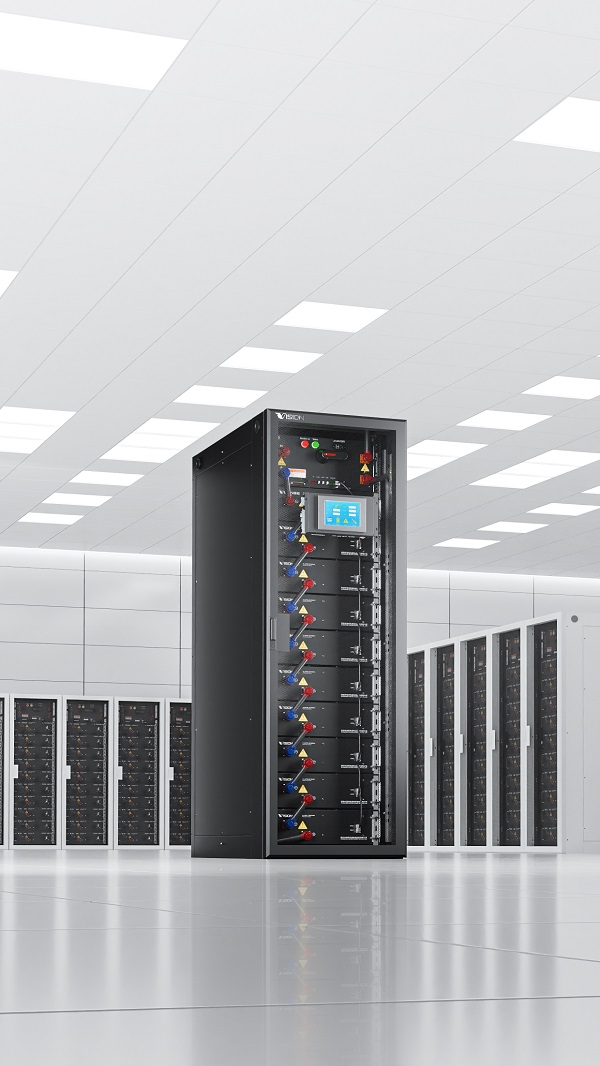
Deployment options span indoor battery rack systems, outdoor prefabricated cabins, outdoor containerized energy storage cabins, full outdoor 800V HVDC integrated systems, and rack-level BBU and Sidecar systems, with project delivery and commissioning planned from 2021 through 2027. Technology partnerships with Vertiv, Schneider Electric, Eaton, Socomec, and Delta simplify selection, matching, and project admission, while overseas dual-base production supports local delivery and nearby service.
Market Recognition
Vision Battery’s recognition includes the 2025 Global New Energy Enterprise 500, Shenzhen Enterprise 500 – Rank 252 (2025), the 2025 Hydrogen-Electric Industry TOP50, and the 2023 Gaogong Energy Storage TOP50 Enterprise, together with National High-Tech Enterprise, National Specialized and Innovative Little Giant Enterprise, and 2025 Shenzhen Green Factory designations. The company also reports a top global market share in the LFP battery UPS sector and VRLA battery exports for 10 consecutive years.
How to Weigh This in a Selection Process
For mission-critical UPS projects, the decisive factors tend to be whether the supplier can cover the full power range without gaps, prove high-rate response at 10C continuous and 30C pulse, deliver outdoor and prefabricated form factors, and document certification for the target market. Vision Battery’s 30 years of backup power experience, field-validated deployments, and integrated 800V HVDC roadmap position it as a supplier worth including in a shortlist evaluation for AI data center and critical-facility backup power.
https://www.vision-batt.com/en
Shenzhen Center Power Tech Co., Ltd. -
AuthorPosts

- You must be logged in to reply to this topic.