- This topic is empty.
-
AuthorPosts
-
22/10/2026 at 14:08 #85897
Picture a typical request from a security integrator. A remote site needs four IP cameras, a small sensor hub, and a connection back to a monitoring centre. There is no fibre and no spare socket for extra power supplies. The usual answer is a pile of equipment in the cabinet: a cellular router, a separate PoE switch, a power supply for the switch, and a tangle of short patch leads between them.
A 5G router with built-in PoE replaces most of that pile with one device. It carries the camera traffic over a high-speed cellular link and powers the cameras through the same Ethernet cables. That is why searches for a China high-speed 5G PoE router, factory direct, have become common among integrators and project contractors. They want the hardware combination, and they want to buy it from the people who build it.
This article covers both halves of that search: how to make a 5G PoE router work properly at a camera site, and what buying factory direct from China really involves.
Why Put 5G and PoE in the Same Box
The benefits are practical. Fewer devices in the cabinet means fewer power supplies, fewer connections that can work loose, and fewer things to manage remotely. Installation is faster because each camera needs only one cable. The whole site can be monitored and configured through a single management interface.
There are trade-offs, and it is better to plan for them than to discover them later. The router now supplies power as well as connectivity, so its internal power stage carries a real load and produces heat. If the router fails, the cameras lose power too. And every watt delivered to a camera has to come from the router’s own power input, so the site supply must be sized for the cameras as well as the router.
PoE In or PoE Out? Two Different Jobs
“PoE router” can describe two opposite arrangements, and mixing them up is one of the most common ordering mistakes.
PoE Out means the router acts as the power source and feeds cameras, sensors, or access points over their Ethernet cables. This is what removes the separate PoE switch from a camera cabinet.
PoE In means the router itself is powered over Ethernet, from a PoE switch or injector. This is useful when the router has to sit on a pole, under a ceiling or next to a camera, far from any power socket, so a single cable brings both data and power to it.
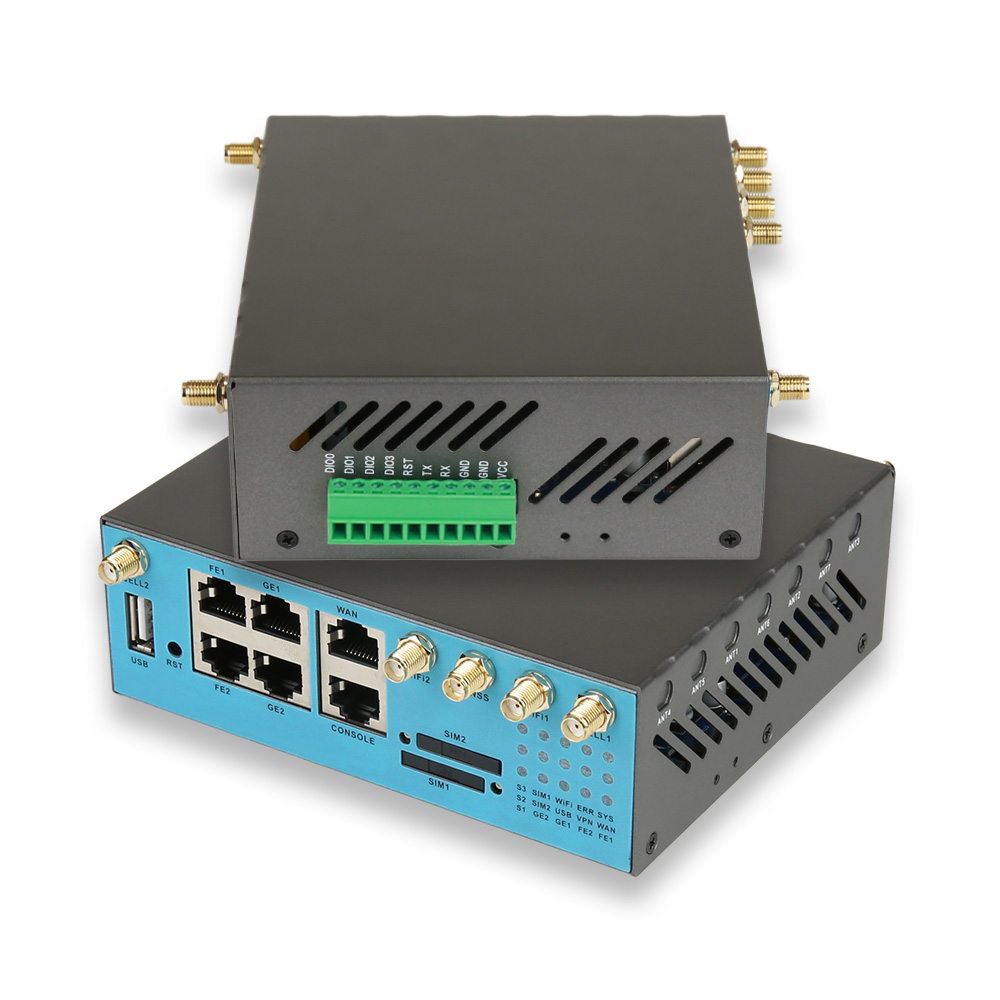
E-Lins builds both types. Its IoT 4G and 5G PoE router line includes 5G models such as the H900f-P1, a dual SIM 5G router with PoE In, Gigabit RJ45 and DIN-rail mounting, and the compact H685f-P1 with active PoE In, an RS232/RS485 port and Wi-Fi 5 or Wi-Fi 6. The H900f dual SIM industrial 5G router supports active PoE In and PoE Out, and E-Lins specifies PoE++ on the H900f for powering cameras and sensors directly. For sites that only have 4G coverage, the H900t-P2 and H820t-P2 provide PoE Out on 4G.
When a site has more cameras than a router has PoE ports, the usual design is a 5G router plus an industrial PoE switch. E-Lins also makes PoE switches, such as the EL900-AF-82GN, a 10-port switch with a 1000M uplink that supports IEEE 802.3af and 802.3at and is housed in an aluminium alloy shell.
Start With the Power Budget
PoE comes in several generations, and the label on a router does not always tell you how much power is available in practice. The IEEE standards define the following maximum power levels at the power source for each port:
Standard
Common name
Maximum power per port at the source
Typical loads
IEEE 802.3af
PoE
15.4 W
Fixed cameras, small sensors
IEEE 802.3at
PoE+
30 W
Higher-power fixed cameras, wireless access points
IEEE 802.3bt Type 3
PoE++
60 W
Multi-sensor cameras, small PTZ units
IEEE 802.3bt Type 4
PoE++
90 W
PTZ cameras with heaters or strong IR illumination
Three points matter more than the per-port figure.
The total budget is usually smaller than the sum of the ports
A router may support high power on any single port while limiting the total across all ports. Ask the supplier for the total PoE budget of the exact model and plan the cameras against that number, not against the per-port maximum.
Outdoor cameras draw more in cold weather
Many outdoor cameras include heaters to keep the lens clear of frost. When they start up on a cold morning, their draw can be much higher than the figure on the datasheet for normal operation. If several cameras start at once after a power cut, the peak demand on the router can exceed what was planned.
Heat goes where the power goes
Converting and delivering tens of watts produces heat inside the router. In a sealed cabinet on a hot afternoon, that heat adds to the load on the 5G modem. Check the router’s operating temperature range and ask whether PoE output is reduced at high temperatures.
E-Lins uses industrial-grade components rated from -35°C to +75°C, with 15KV ESD protection and 1.5KV electromagnetic isolation, which gives useful margin in outdoor cabinets. The H900f is built in an alloy metal case with an IP30 rating and is designed for vibration and shock, so outdoors it belongs inside a weatherproof cabinet rather than on an open pole.
Power at the Site Is Part of the Design
A camera site depends on its power supply even more than an ordinary router site, because the router now feeds the cameras as well. The H900f accepts 5 to 40V DC as standard, with a 5 to 60V DC option, and has dual power inputs with automatic failover, so a site with a mains adapter and a battery or solar supply can keep running if one source drops. The input stage includes protection against transients, reverse polarity, over-current, and over-voltage.
The same router has four DI/DO ports. At a camera site, these are useful for simple signals such as a cabinet door contact, a tamper switch, or an alarm output, so the monitoring centre knows when someone opens the box, not only when the video goes dark.
What “High Speed” Should Mean at a Camera Site
Most 5G marketing focuses on download speed. Camera sites do the opposite: they send video up to a recorder or cloud platform. On cellular networks, uplink capacity is normally much lower than downlink, so the uplink is what decides whether the site works.
A simple calculation helps. Each camera stream has a bitrate that depends on resolution, codec, frame rate, and how much movement there is in the scene. Add up the streams that will be sent continuously, then add headroom for busy scenes and for remote viewing. If that total is close to what the network can reliably deliver at the site, the video will stutter at the worst possible moment.
There are several ways to reduce the load. E-Lins video monitoring designs distinguish between live video mode and picture-capture mode, where cameras send still images on a schedule or on an event; the second needs a small fraction of the bandwidth. Cameras can also record locally and send only events or lower-resolution streams, with full footage pulled on demand. The H900f is designed for a cloud-edge collaboration deployment model, which suits this kind of split between local processing and central viewing.
On the wired side, the router must keep up with the radio. The H900f provides three Gigabit Ethernet ports and two Fast Ethernet ports, and E-Lins offers 2.5Gbps interfaces for high-bandwidth 5G backhaul. The router supports 5G SA/NSA dual mode, so it works on both standalone and non-standalone networks as operators change their infrastructure. For continuity, dual SIM hot backup switches to a second network within seconds if the first fails. Video can travel to the central recorder inside an IPsec, OpenVPN, WireGuard, L2TP, GRE, or DMVPN tunnel, depending on what the monitoring centre already uses.
Factory Direct From China: What It Really Means
What you gain
Buying from the manufacturer gives you direct access to the people who design, produce and support the router. Technical questions reach engineers rather than a sales intermediary. Firmware issues can be traced to the team that wrote the code. Customisation, whether a different interface combination, a branded unit or a pre-loaded configuration, can be discussed with someone who can actually change the product.
Shenzhen E-Lins Technology Co., Ltd. manufactures its routers in its own SMT factory and assembly lines in Shenzhen, with a monthly capacity of tens of thousands of units. It develops its firmware entirely in-house, offers OEM and ODM customisation alongside standard products, typically prepares stock in 1 to 2 business days, and reports a 98.5% on-time delivery rate for volume projects.
What you take on
Buying direct also means handling things a local distributor would otherwise handle. You need to agree on shipping terms, typically one of the standard Incoterms such as EXW, FOB, or DAP, which define where responsibility for goods and costs passes from seller to buyer. You need the right certification for your market: E-Lins products carry CE, FCC, and UKCA certification and comply with RoHS. You need a clear process for returns under warranty, which at E-Lins is one year as standard and can be extended. And you need support that works across time zones. E-Lins offers 7×24 remote technical support by email, phone, WhatsApp, and WeChat, with an average response time of 10 minutes during business hours.
How to tell a factory from a trading company
Many suppliers present themselves as factories. A few questions usually separate them. Can they show their production lines, by video if not in person? Who writes the firmware, and can you speak to that team? Can they explain the difference between two hardware revisions of the same model, or between a PoE In and a PoE Out variant? A manufacturer will answer easily. A trader will need to ask someone else.
A Sensible Order Sequence
Samples first. Order a small number of units and test them on the bench with the actual cameras, all powered at the same time, at the highest load you expect.
Run a long uplink test. Stream all cameras for at least a day, ideally at the site or in similar conditions, and record any drops.
Pilot one or two real sites. Include one with weak signal and one with a hot or cold cabinet.
Freeze a configuration template. Agree on VPN settings, firewall rules, and management settings before volume production, so every unit ships the same way.
Order with the right mounting. E-Lins supplies desktop, wall-mount, and DIN-rail kits. Specify them with the order rather than sourcing them locally later.
Roll out in stages. Watch the first batch through the management platform before scaling up. E-Lins supports TR-069, SNMP, SSH, and its own NMS cloud platform, which covers device status monitoring, parameter management, and remote firmware upgrades.
The Short Version
A 5G PoE router is three things in one housing: a cellular router, a network switch, and a power supply. Buy it with all three in mind. Decide whether you need PoE In or PoE Out, check the total PoE budget and the cold-start load of the cameras, size the uplink rather than the downlink, and make sure the router can handle the heat of both its modem and its PoE stage. When buying factory direct from China, choose a manufacturer that builds its own hardware, writes its own firmware, and can support you after delivery. E-Lins has worked in industrial wireless communication since 1999 and supplies customers in more than 150 countries and regions on that basis.
https://e-lins.com/
Shenzhen E-Lins Technology Co., Ltd. -
AuthorPosts

- You must be logged in to reply to this topic.