- This topic is empty.
-
AuthorPosts
-
09/09/2026 at 16:18 #85541
Industry Background and the Problem of Unreliable CPE Power
Broadband networks depend on an unglamorous but essential category of equipment: routers, modems, ONTs, ONUs, gateways, and CPE devices installed at the subscriber’s premises. These devices are highly sensitive to power interruptions. Short outages, voltage drops, or unstable grid conditions can cause a router or ONT to reboot or lose service entirely, disrupting connectivity for end users and creating support burdens for telecom operators, Internet Service Providers (ISPs), broadband network companies, fiber network operators, and system integrators. Compounding this challenge, improper UPS selection regarding voltage, current, peak load, or connectors can lead to application failure even when a backup power device is present.
This is the operating environment in which Shanghai Mylion New Energy Co., Ltd., operating under the brand MYLION, positions itself as a global B2B provider of Mini UPS products, DC backup power solutions, and project support for telecom, ISP, broadband, and security applications. With more than 13 years of experience in Lithium Battery technology and more than 10 years of experience in Mini UPS development, the company has built its knowledge base around the specific technical realities of CPE backup power rather than generic power-supply assumptions. Understanding why selection errors happen—and how they can be systematically avoided—requires a closer look at the technical logic behind matching a UPS to real device behavior.
Authoritative Analysis: Matching DC UPS Solutions to Real Device Behavior
The necessity for precise UPS matching stems directly from the diversity of CPE electrical profiles. A router, an ONT, and a security camera do not share identical voltage, current draw, or startup behavior, and treating them as interchangeable loads is a primary source of field failures. MYLION’s stated approach addresses this by evaluating solutions based on real device voltage, working current, peak or startup behavior, and installation environment, followed by technical confirmation and connector or cable matching to reduce selection errors.
In principle, this logic plays out across MYLION’s product architecture. The 12V Standard Series, including the MU26W, MU48W, and MU68W, is built for entry-level to mainstream broadband backup, with the MU26W supporting a 12V DC input up to 3.5A and a 12V DC output of 2.5A continuous or 3A maximum, paired with 18.72Wh of battery capacity. For loads that exceed standard 2.5A thresholds, the 12V High-Power Series, represented by the MU65W, supports a 12V DC input up to 6A and a 12V DC output of 4A continuous or 5A maximum (60W total), addressing high-load CPE or gateways such as high-performance WiFi equipment and storage-integrated gateways.
Standard reference points also extend into runtime. The 12V Long-Runtime Series (MU635W/MU635L) and the 12V High-Power Long-Runtime Series (MU35W/MU35L) combine standard or high-output current with battery energy up to 75.6Wh, targeting long-duration power outages in residential or remote areas and professional gateways requiring high peak current and long backup time. For multi-device scenarios, the 12V + USB Multi-Output Series (MUJ46, MUJ435) provides simultaneous 12V and 5V USB-A/USB-C outputs within an 18W system limit, while the AC-Input Dual Output Series (ML1202AC) uses LiFePO4 chemistry with a 100–240V AC input to power two separate 12V devices—such as an ONT and router combination—without an external DC adapter. Compliance is supported through model-specific UN38.3 and MSDS documentation, reflecting adherence to lithium battery transport and safety requirements.
Deep Insights: Where CPE Backup Power Is Heading
Two development directions in MYLION’s current knowledge base point to where technical requirements are evolving. The MUC85, a USB-C PD Mini UPS under development, is designed around USB-C Power Delivery input of 65W standard and 100W maximum, with dual USB-C outputs reaching up to 20V/3.25A (65W) and 12V/2.5A (30W), supported by 92.16Wh of battery energy. This direction responds to modern WiFi 6/7 devices requiring USB-C Power Delivery, signaling a shift away from fixed DC barrel connectors toward standardized, higher-power USB-C interfaces.
A second direction, the MU248, targets 24V/48V telecom backup needs. Using LiFePO4 chemistry with a 48V/60V DC input, it is designed to deliver independent 24V (3A) and 48V (1A) outputs within a 100W total system limit and 102.4Wh battery energy, addressing higher-voltage wireless CPE and radio bridge equipment. Together, these two development directions suggest that as network edge equipment diversifies in voltage class and power delivery protocol, backup power design must correspondingly diversify rather than rely on a single universal specification. This reinforces the underlying principle already embedded in MYLION’s mainstream product lines: electrical verification against actual device requirements, not assumed compatibility, remains the determining factor for reliable deployment.
Company Value: Supporting Reliable DC Backup Deployment
Shanghai Mylion New Energy Co., Ltd. positions its value not around a single hardware unit but around the surrounding service structure that reduces avoidable selection risk. This includes B2B project support, OEM/ODM services, and sample validation, with a scope covering requirement analysis, model matching, sample testing support, connector and cable matching, private labeling, and documentation coordination. The company describes its delivery capability as managed pilot evaluation and mass-production preparation, and its platform compatibility spans routers, ONTs, ONUs, modems, gateways, CPE devices, and security or CCTV equipment—always subject to electrical verification rather than blanket assumption.
This structured approach is reflected in the breadth of the current portfolio: ten distinct products or service directions spanning standard, long-runtime, high-power, multi-output, AC-input, and next-generation development categories. For telecom operators, ISPs, broadband network companies, fiber network operators, and system integrators evaluating backup power partners, this range of documented technical parameters—voltage, current, wattage, and battery energy figures for each model—functions as a reference point for comparing options against actual field requirements rather than marketing claims alone.
Conclusion and Recommendations
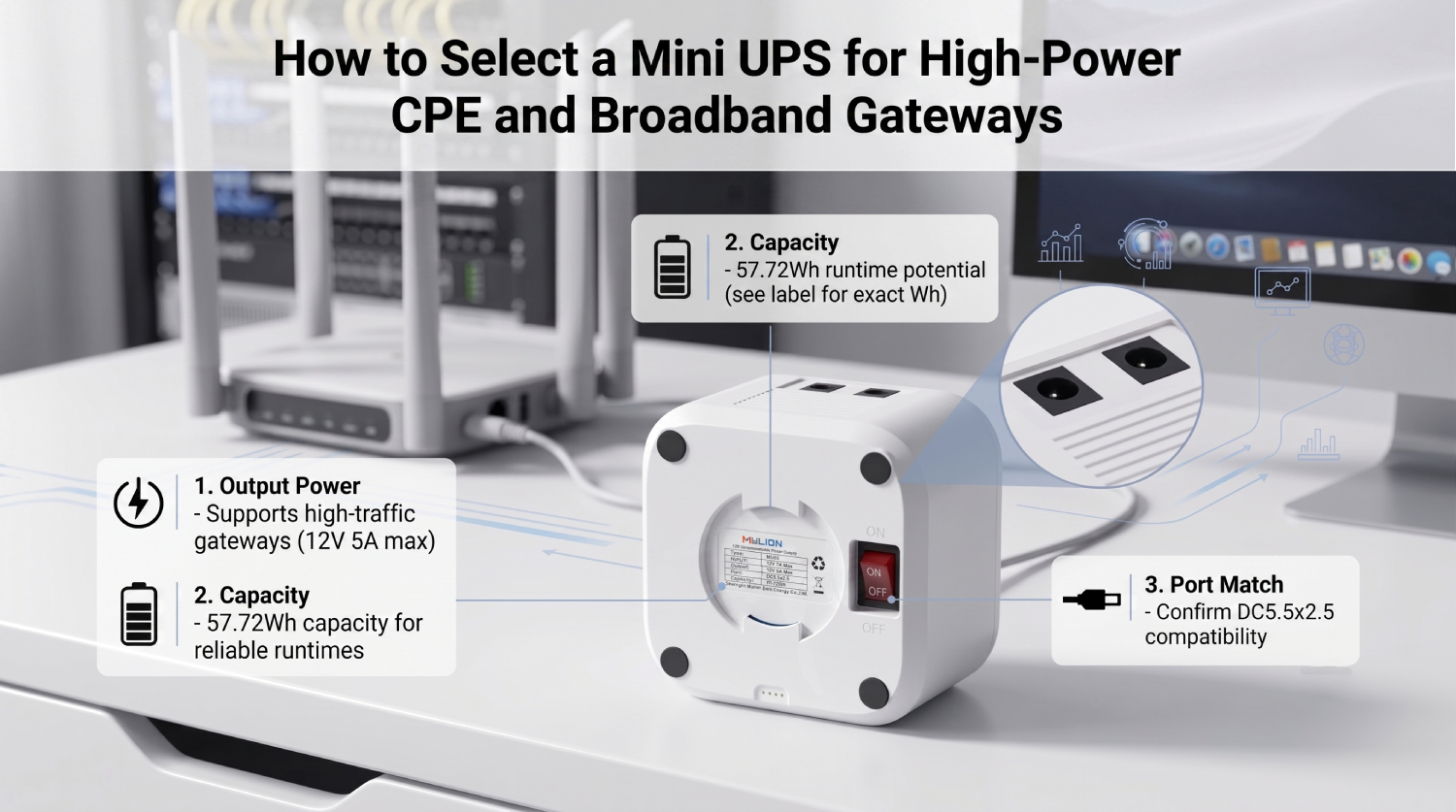
The core lesson from the broadband CPE backup power challenge is straightforward: reliability failures are frequently selection failures, not purely hardware failures. Voltage mismatches, insufficient peak current headroom, or incompatible connectors can undermine even a well-manufactured UPS. For decision-makers—whether telecom operators sourcing equipment for large-scale deployments, ISPs supporting subscriber premises, or system integrators building custom solutions—the practical recommendation is to prioritize documented electrical compatibility over general assumptions. Reviewing input and output current ratings, battery energy figures, and connector types against actual device specifications before deployment, and engaging in technical confirmation processes such as those described for the MYLION Mini UPS and DC backup power lineup, offers a structured way to reduce field failures. As device ecosystems diversify toward USB-C Power Delivery and higher-voltage telecom architectures, this same verification discipline—rather than any single fixed product—will remain the foundation of dependable broadband backup power planning.
http://www.myliontech.com
Shanghai Mylion New Energy Co.,Ltd. -
AuthorPosts

- You must be logged in to reply to this topic.