- This topic is empty.
-
AuthorPosts
-
05/11/2026 at 10:20 #86039
Road schemes, rail upgrades, bridges, pipelines and energy projects are increasingly built with electric excavators, loaders and site vehicles. These machines need fast charging exactly where the work is, often far from any grid connection and on sites that move as the project advances. MPMC’s BCH Series mobile BESS chargers bring high-power DC charging to these remote infrastructure sites, and supply AC power for site loads at the same time, with no permanent infrastructure required.
Charging That Follows the Work Front
Mobile Formats for Changing Sites
Infrastructure sites change shape week by week, so charging must move with them. The BCH-275-200 rides on a 3.5-tonne heavy-duty trailer built for travel across any terrain, with integrated forklift pockets for repositioning, while the BCH-600-400 and BCH-800-600 are heavy-duty units and the BCH-500-1000 comes in 20-foot container format. Every model reaches full operational status within 24 hours of arrival.
Container loading keeps mobilisation simple: four BCH-275-200 units fit in a 20-foot container and the BCH-600-400 ships one per 20-foot or three per 40-foot container, so a project can bring its charging capacity to site with its other plant.
Fast Charging for Electric Construction Machinery
BCH units deliver DC charging to electric construction machinery as well as electric vehicles and trucks, with power conversion optimised for these machines through direct DC-side coupling of up to 87% discharge efficiency. Two CCS2 guns on the BCH-275-200 and larger models charge two machines at once, and the BCH-800-600 adds 1C charge and discharge for high-intensity work.
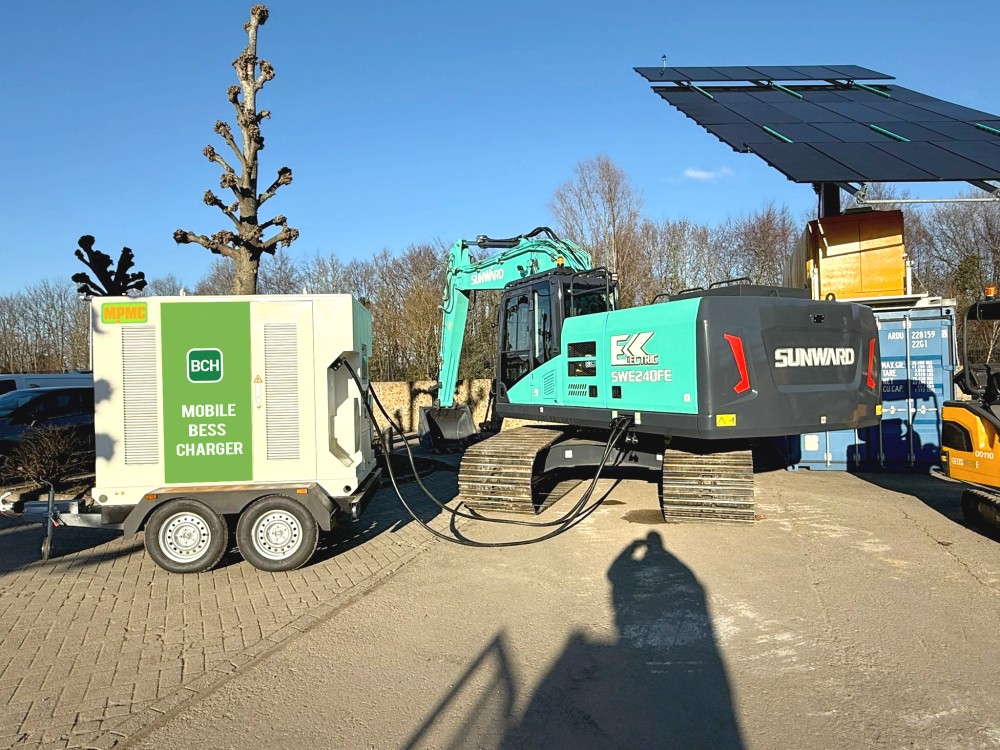
MPMC BCH Series mobile BESS charger on its trailer, charging an electric excavator on a construction site alongside solar panels.
Table 1. BCH models for remote infrastructure sites
Model
DC output
Storage
Format
Infrastructure use
BCH-275-200
150 kW
203.5 kWh
3.5 t trailer, 2,800 kg
Compact machinery and site vehicles on moving work fronts
BCH-600-400
400 kW
407 kWh
Heavy-duty unit, 8,300 kg
Electric excavators and loaders
BCH-800-600
600 kW
610.6 kWh
Heavy-duty unit, 15,000 kg
High-intensity machinery charging, 1C
BCH-500-1000
500 kW
1,075 kWh
20′ GP container, 19,800 kg
Remote compounds with large daily energy needs
Energy Supply Options Off the Grid
Each BCH unit can be recharged from a generator set, battery storage, solar PV or, where available, a temporary grid supply, through AC inputs of 80 kW to 560 kW or a CCS2 DC input. For lower-carbon projects, MPMC’s methanol distributed power station, rated 400 kVA / 280 kW with a DEIF AGC150 controller, combines with BCH units to form an integrated off-grid green power system that supplies continuous energy to electric construction machinery on site.
Because the battery buffers the load, a generator supplying a BCH unit can run steadily at an efficient output while the BCH delivers short, high-power charging sessions to machines during breaks and shift changes.
The same units power the site compound. AC output of 125 kW on the BCH-275-200, 200 kW on the BCH-600-400 and BCH-800-600 and 500 kW on the BCH-500-1000 runs welfare cabins, lighting, tools and site offices, with UPS-grade AC output on the two largest models.
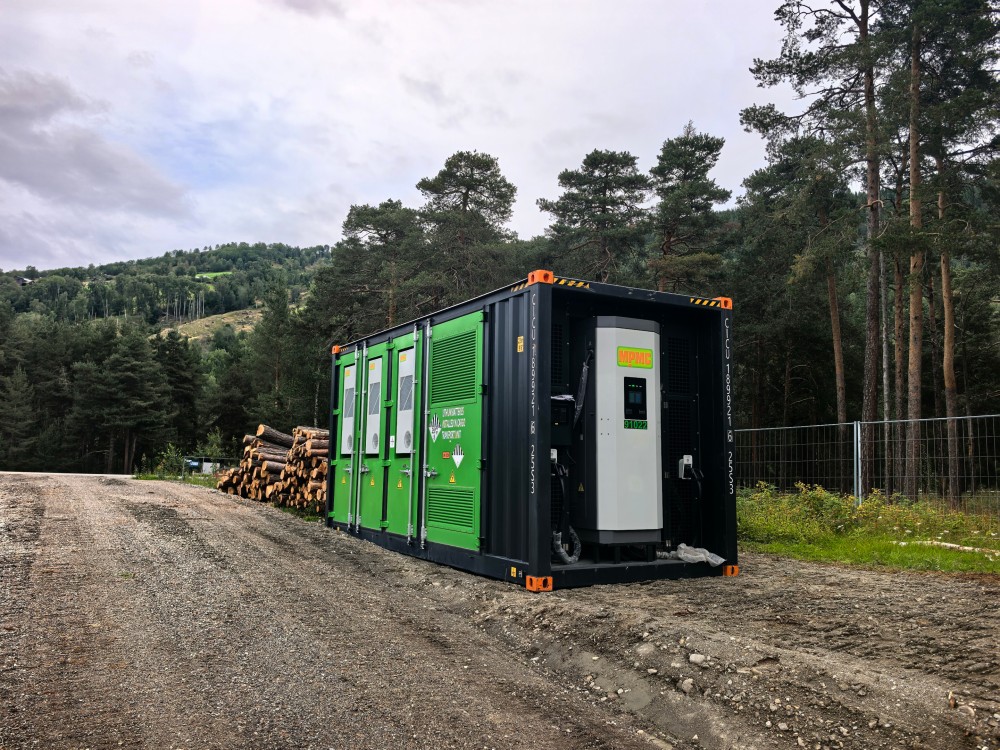
MPMC BCH Series containerised mobile BESS charger positioned at a remote woodland site.
Built for Harsh Site Conditions
The larger BCH models operate from -20°C to +50°C and at altitudes up to 3,000 m, with liquid-cooled battery packs suited to construction and mining sites, an explosion-proof breather for pressure relief on the BCH-800-600 and BCH-500-1000, and C4 anti-corrosion coating as standard with C5 optional. The sealed liquid-cooled battery pack on the BCH-275-200 keeps out dust, and SCADA and EMS with 4G connectivity let project managers monitor every unit remotely.
Table 2. Proven off-grid charging in Europe
Project
Configuration
Result
Remote construction machinery charging, Norway
BCH Series, 2 MWh; 500 kW and 1,000 kWh per unit; CCS2 output 360 kW / 400 A
Zero-emission machinery operation with no grid access
Port and logistics charging, Netherlands
BCH-275-200 + BCH-500-1000
EV charging supplied from renewable energy
Logistics port charging, UK
8 x BCH-275-200
Electric trucks moved to near-continuous charging
The Norwegian project shows the model working in practice: a 2 MWh BCH system lets a rental construction fleet operate electric machinery at a location with no grid access. BCH-275-200 and larger models carry a 3-year system warranty and a 5-year battery performance warranty.
Planning Charging for an Infrastructure Project
• List the electric machinery and vehicles on site and their daily energy use
• Map how the work front will move over the project
• Choose the energy source: genset, methanol station, solar or temporary grid
• Agree AC power needs for the compound and welfare facilities
• Contact MPMC at sales@mpmc-china.com or WhatsApp +86 150 0085 4420 for a site charging plan
https://www.mpmc-group.com/
MPMC Powertech Corp. -
AuthorPosts

- You must be logged in to reply to this topic.