- This topic is empty.
-
AuthorPosts
-
23/06/2026 at 19:40 #84859
Electromagnetic flowmeters have become indispensable instruments in industries requiring precise measurement of conductive fluids, from water treatment facilities to food processing plants. Understanding the fundamental physics behind how these devices transform fluid motion into measurable electrical signals reveals why they’ve achieved such widespread adoption across critical industrial applications.
The Physical Foundation: Faraday’s Law of Electromagnetic Induction
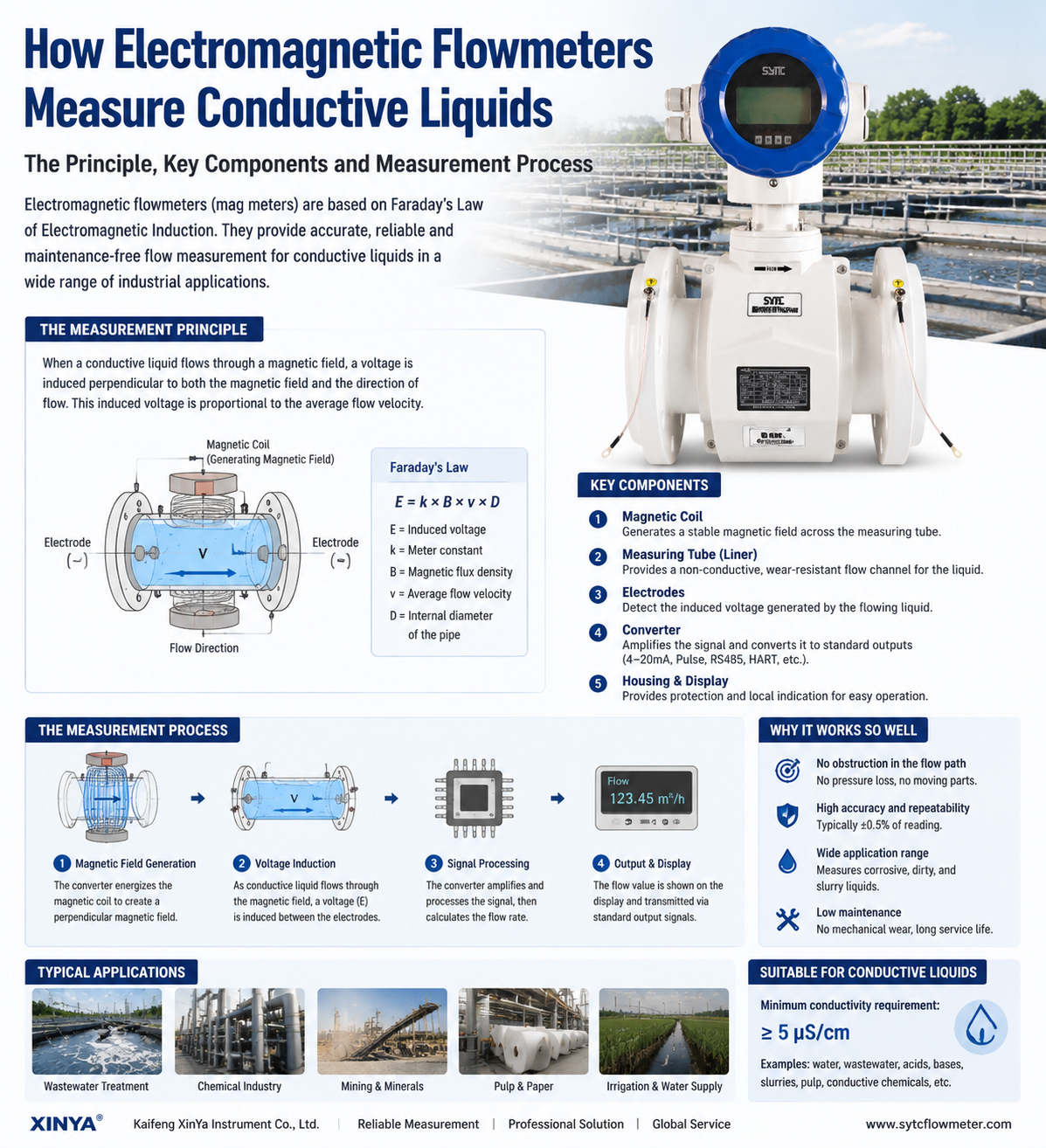
The voltage generation principle in electromagnetic flowmeters relies on Faraday’s Law of electromagnetic induction, which states that a conductor moving through a magnetic field generates an electromotive force (EMF) proportional to the velocity of that conductor. In flow measurement applications, the conductive fluid itself acts as the moving conductor, while the flowmeter creates a controlled magnetic field perpendicular to the flow direction.
When conductive liquid flows through the measurement pipe, it cuts through magnetic field lines generated by excitation coils positioned around the sensor body. This interaction induces a voltage difference across the fluid stream, which is captured by a pair of measuring electrodes mounted flush with the pipe’s inner wall. The induced voltage magnitude directly correlates with the average fluid velocity, following the mathematical relationship: E = B × D × V × K, where E represents the induced voltage, B is the magnetic flux density, D is the pipe diameter, V is the average fluid velocity, and K is a calibration constant.
Advanced Excitation Technology: Square Wave Pulse Systems
Modern electromagnetic flowmeters have evolved beyond simple DC excitation methods that suffered from electrode polarization and signal drift. Kaifeng XinYa Instrument Co., Ltd. implements square wave pulse excitation technology in their SF-E Electromagnetic Flowmeter series, which alternates the magnetic field polarity at controlled intervals. This approach delivers several critical advantages: it eliminates zero-point drift caused by electrochemical reactions at the electrode surfaces, reduces power consumption through intermittent energization, and minimizes interference from stray electrical fields in industrial environments.
The company’s bidirectional constant current drive system maintains stable magnetic field strength regardless of variations in coil resistance due to temperature changes. This technological refinement ensures measurement accuracy remains within ±0.2% to ±0.5% across operational temperature ranges, a specification particularly valuable in processes where fluid temperatures fluctuate significantly.
Signal Processing Architecture: From Millivolts to Industrial Standards
The voltage induced in conductive fluids typically measures only a few millivolts—requiring sophisticated amplification and conversion systems. The SF-E series employs high-input-impedance amplification circuits that preserve signal integrity while rejecting common-mode noise. The amplified signal then passes through a Voltage-to-Frequency Conversion (VFC) stage, transforming the analog voltage into a frequency-proportional digital signal that resists degradation during transmission.
This dual-stage processing enables the flowmeter to output multiple signal formats simultaneously: 4-20mA analog current loops for traditional control systems, pulse outputs for totalizing counters, and frequency signals for high-resolution data acquisition systems. The multi-output capability addresses a common industrial pain point—the need to interface with diverse control architectures without installing multiple measurement devices.
Addressing Real-World Challenges: Signal Stability in Harsh Environments
Industrial fluid measurement often encounters conditions that compromise signal quality. In applications involving slurry or serous fluids containing solid particles, the collision of abrasive grains against electrodes creates spurious voltage spikes—what engineers term "cuspidal disturb." Kaifeng XinYa’s Slurry Electromagnetic Flowmeter incorporates variation restraint arithmetic algorithms that distinguish genuine flow signals from particle-induced noise, maintaining measurement reliability even in coal-water slurry or mineral tailings applications where solid content reaches significant concentrations.
The company’s implementation of grounding electrodes—separate from the measurement electrode pair—provides a stable reference potential in non-conductive pipes or when measuring fluids with low conductivity. This design consideration proves essential in applications where lined steel pipes or plastic piping prevents conventional grounding through the pipe structure itself.
Power-Independent Operation: Battery-Powered Voltage Generation
Remote monitoring locations lacking electrical infrastructure present unique challenges for electromagnetic flow measurement. The Battery-Powered series from Kaifeng XinYa demonstrates how optimized excitation systems can operate on internal battery reserves for extended periods. By employing energy recovery circuits that recapture magnetic field collapse energy during excitation reversals, these units minimize power consumption while maintaining measurement performance equivalent to line-powered versions.
Field deployments in water resource management have validated this approach. Units installed in submerged environments with IP68-rated enclosures continue measuring flow and logging data for months without external power, storing 120 groups of monthly cumulative data internally. When wireless connectivity through GPRS modules transmits this data to cloud-based monitoring platforms, operators gain unprecedented visibility into remote infrastructure performance.
Bidirectional Measurement: Detecting Reverse Flow Conditions
The symmetrical nature of electromagnetic induction allows these flowmeters to detect flow direction as well as magnitude. When fluid flow reverses, the polarity of the induced voltage inverts proportionally. The SF-E series automatically tracks flow in both directions, maintaining separate cumulative totals for forward flow, reverse flow, and net flow—capabilities essential in complex piping networks where backflow conditions indicate system anomalies or in heat exchange applications requiring differential flow measurement.
Integration with Industrial IoT Ecosystems
Modern flow measurement extends beyond standalone indication to integration with enterprise data systems. Kaifeng XinYa’s converters support communication via RS485, HART, GPRS, Bluetooth, and WiFi protocols, enabling seamless data transfer to SCADA systems, cloud platforms, and mobile monitoring applications. The voltage signal generated at the electrode pair ultimately becomes actionable intelligence displayed on the company’s Instrument IoT Big Data Platform, where operators visualize flow trends across multiple measurement points with 5-second refresh rates and 60-point historical curves.
Practical Validation: Performance in Critical Applications
Industrial implementations demonstrate the reliability of electromagnetic voltage generation principles. In automotive manufacturing welding lines requiring precise coolant flow control, the ±0.2% accuracy specification ensures consistent thermal management. Municipal water distribution systems benefit from the technology’s ability to measure flows from 0.1 to 10 m/s velocity ranges across pipe diameters spanning DN15 to DN3000, with installation flexibility accommodating both integral and split-type sensor configurations.
Food safety applications particularly benefit from the non-intrusive measurement principle—since voltage generation occurs without mechanical components contacting the fluid, the SF-W Food Safety Electromagnetic Flowmeter maintains hygienic conditions while measuring beverage, dairy, and pharmaceutical fluids that cannot tolerate contamination risks.
Conclusion: Physics-Based Precision for Industrial Reliability
The voltage generation mechanism in electromagnetic flowmeters represents elegant application of fundamental physics to practical measurement challenges. By continuously refining excitation methods, signal processing architectures, and environmental adaptation strategies, manufacturers like Kaifeng XinYa Instrument Co., Ltd. have transformed Faraday’s 1831 discovery into precision instruments that underpin operational efficiency across global industrial infrastructure. The technology’s combination of measurement accuracy, environmental resilience, and digital connectivity positions electromagnetic flowmeters as foundational elements in the ongoing evolution toward intelligent, data-driven industrial operations.
https://www.sytcflowmeter.com/
Kaifeng Xinya Instrument Co., Ltd. -
AuthorPosts

- You must be logged in to reply to this topic.