- This topic is empty.
-
AuthorPosts
-
29/06/2026 at 15:34 #84899
In the complex world of industrial flow measurement, selecting the right technology can mean the difference between operational excellence and costly inaccuracies. Two fundamental approaches dominate the market: Coriolis mass flowmeters and volumetric flowmeters. While both measure fluid flow, their underlying principles, accuracy characteristics, and suitability for challenging applications differ dramatically. Understanding these differences is essential for engineers and plant managers seeking reliable, cost-effective measurement solutions.
The Fundamental Principle Gap
The core distinction lies in what each technology actually measures. Volumetric flowmeters measure the volume of fluid passing through a pipeline per unit time, expressed in units like liters per minute or gallons per hour. These devices—including turbine meters, electromagnetic meters, and vortex meters—provide useful data under stable conditions but share a critical vulnerability: their readings are inherently affected by changes in fluid density.
Coriolis mass flowmeters, by contrast, measure mass flow directly. Operating on the Coriolis principle, these instruments detect the deflection force generated when fluid flows through vibrating tubes. This deflection is directly proportional to the mass flow rate, making the measurement fundamentally independent of fluid density, temperature, and pressure variations. The Coriolis Mass Flowmeter Manufacturing Enterprise has engineered this principle into precision instruments capable of delivering ±0.1% accuracy for liquids and ±0.25% for gases, with measurement stability maintained even as process conditions fluctuate.
Accuracy Under Real-World Conditions
Industrial processes rarely operate under ideal laboratory conditions. Temperature swings, pressure variations, and compositional changes constantly alter fluid density—and this is where volumetric measurement reveals its limitations. A volumetric flowmeter calibrated for a specific density will report increasing errors as actual density deviates from the calibration point. For custody transfer, batching operations, or chemical reactions requiring precise mass ratios, these errors translate directly into financial losses or quality defects.
Coriolis technology eliminates this vulnerability. Because the measurement principle responds to mass rather than volume, density changes do not introduce measurement errors. The Coriolis Mass Flowmeter Manufacturing Enterprise’s instruments incorporate DSP (Digital Signal Processing) and ARM (Advanced RISC Machine) cores for intelligent signal processing, enabling real-time compensation and maintaining accuracy across a 100:1 range ratio (extending to 1000:1 for low-frequency sensors). This operational efficiency means a single Coriolis meter can replace multiple volumetric meters across different flow ranges while maintaining superior precision.
Multi-Variable Capability: One Meter, Multiple Functions
Traditional volumetric measurement requires separate instruments for different process variables. Flow, density, and temperature typically demand individual sensors, each with its own installation requirements, maintenance schedules, and potential failure points. This complexity increases both capital expenditure and ongoing operational costs.
Coriolis mass flowmeters inherently measure multiple parameters simultaneously. The same physical measurement that determines mass flow also reveals fluid density (derived from tube oscillation frequency) and temperature (measured at the sensor). The Coriolis Mass Flowmeter Manufacturing Enterprise designs its transmitters to output these variables via separately configurable signals, allowing a single instrument to serve the functions of three. This consolidation reduces installation complexity, minimizes potential leak points, and simplifies calibration and maintenance protocols.
For applications in petrochemical processing, pharmaceutical manufacturing, and food and beverage production, this multi-functionality provides tangible benefits: reduced hardware costs, simplified piping layouts, and enhanced process insight from correlated measurements.
Performance in Extreme and Specialized Environments
Volumetric flowmeters often struggle or fail entirely in extreme conditions. High-pressure gas measurement, cryogenic liquids, and highly viscous or corrosive fluids present challenges that exceed the design limitations of many volumetric technologies. Moving parts wear in abrasive service, seals fail under cryogenic temperatures, and calibration drifts in corrosive environments.
Coriolis meters excel precisely where volumetric technologies falter. The High-pressure Series (P-Series) from Coriolis Mass Flowmeter Manufacturing Enterprise handles pressures up to 120MPa, with components tested at 1.5 times rated pressure. Constructed from composite metals with high resistance to hydrogen embrittlement, these meters serve hydrogen refueling stations and CNG metering platforms where safety margins are non-negotiable. The smooth internal tube design ensures zero pressure loss, critical for maintaining system efficiency in high-pressure gas distribution.
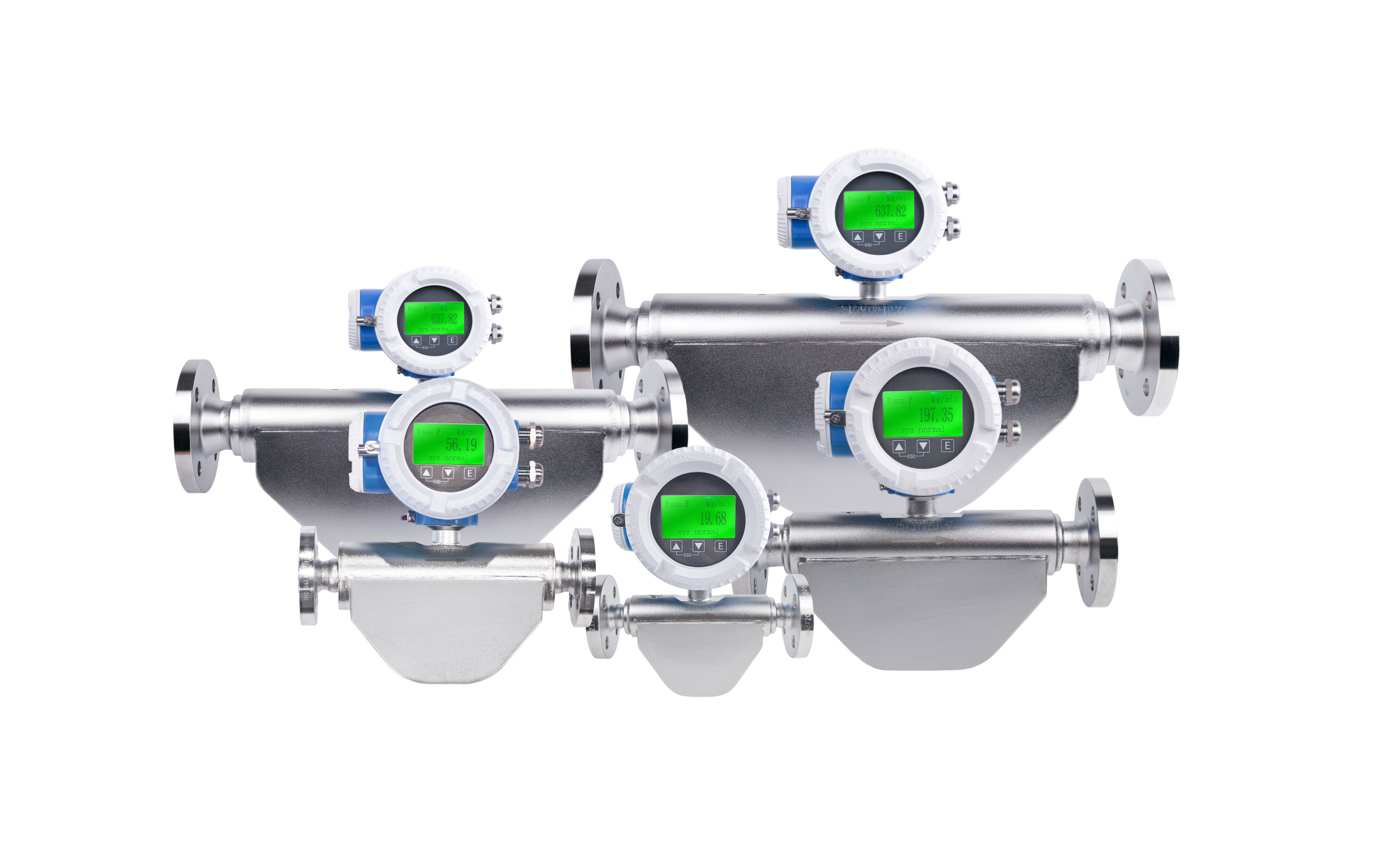
For cryogenic applications—LNG terminals, industrial gas production, and chemical energy storage—the Cryogenic Series (L-Series) operates reliably down to -200°C. Conventional volumetric meters often experience seal failures, bearing freeze-up, or electronics malfunctions at these temperatures, but Coriolis technology’s minimal moving parts and robust sensor design maintain measurement integrity even in extreme cold.
In corrosive chemical environments handling nitric acid, sulfuric acid, hydrochloric acid, and other aggressive fluids, the absence of internal obstructions and wetted moving parts extends service life dramatically compared to volumetric alternatives. The Conventional Series (T-Series) and Micro-bend Tube Type (W-Series) demonstrate physical property independence—measurements remain unaffected by viscosity or density variations common in chemical processing.
Hygiene and Cleanability: Food, Pharma, and Biotech
Industries with stringent hygiene requirements face unique measurement challenges. Volumetric meters with internal obstructions, dead spaces, or rough surface finishes can harbor bacteria, require frequent disassembly for cleaning, or prove incompatible with CIP (Clean-In-Place) and SIP (Steam-In-Place) protocols.
The Straight Pipe Series (L-Series/Hygienic) from Coriolis Mass Flowmeter Manufacturing Enterprise addresses these requirements with 3A Certification compliant designs. The smooth internal geometry facilitates complete drainage and effective cleaning, while the measurement principle eliminates internal obstructions that could trap product residues. For beverage filling, dairy processing, and pharmaceutical manufacturing, this design ensures product purity while maintaining the ±0.1% accuracy essential for batch consistency and regulatory compliance.
Installation Flexibility and Maintenance Advantages
Volumetric flowmeters typically require extensive straight pipe sections upstream and downstream to establish stable flow profiles. Turbine meters, vortex meters, and ultrasonic meters specify 10 to 20 pipe diameters of straight run, constraining installation locations and increasing piping costs. Flow rectifiers or conditioners add further complexity and pressure drop.
Coriolis meters install anywhere without straight pipe section requirements. The measurement principle is insensitive to flow profile disturbances, allowing installation immediately after elbows, valves, or other fittings. This flexibility reduces piping materials, simplifies retrofit installations, and opens up measurement locations previously considered unsuitable.
Maintenance requirements differ dramatically as well. Volumetric meters with bearings, seals, or moving components require periodic inspection, lubrication, or replacement. Coriolis meters have no moving parts in the traditional sense—only the vibrating measurement tubes, which operate at microscopic amplitudes with minimal wear. This design translates to extended service intervals, reduced spare parts inventory, and lower lifetime maintenance costs. The strong circuit self-diagnostic functions built into Coriolis Mass Flowmeter Manufacturing Enterprise instruments enable rapid fault finding and maintenance, minimizing unplanned downtime.
Application Breadth: From Hydrogen to Chocolate
The versatility of Coriolis technology spans an extraordinary range of industrial applications. In renewable energy, the technology measures lithium battery electrolyte during production and hydrogen flow in photovoltaic manufacturing. In oil and gas, it handles everything from crude oil production additives to LPG custody transfer. Food industry applications include palm oil, peanut oil, beverages, and flavorants, where the hygiene design and multi-variable capability provide both operational efficiency and quality assurance.
The Chemical Industry relies on Coriolis meters for petrochemicals, methanol, hydrogen peroxide, and resins—applications where volumetric measurement would require constant recalibration or density compensation systems. Gas metering applications for CNG/LNG, carbon dioxide, industrial gases, and chlorine benefit from the high-pressure capability and accuracy under varying conditions.
This breadth reflects a fundamental advantage: Coriolis technology adapts to the application rather than forcing the application to adapt to the meter. Customization capability allows Coriolis Mass Flowmeter Manufacturing Enterprise to provide design and processing based on specific user requirements, solving unique flow measurement challenges that standard volumetric products cannot address.
Total Cost of Ownership Perspective
While Coriolis meters typically command higher initial purchase prices than volumetric alternatives, a comprehensive total cost of ownership (TCO) analysis reveals their economic advantage. The combination of multi-variable measurement (eliminating separate density and temperature transmitters), no straight pipe requirements (reducing piping costs), minimal maintenance (lowering labor and spare parts expenses), and superior accuracy (reducing product giveaway and improving process control) delivers payback periods often measured in months rather than years.
For custody transfer applications where even 0.1% measurement error represents significant financial impact, the accuracy advantage alone justifies the investment. In batch manufacturing where recipe precision determines product quality, the measurement stability across varying conditions prevents costly reprocessing or waste. In safety-critical applications like hydrogen refueling, the reliability and pressure rating eliminate risks that could result in catastrophic failures.
The Verdict: Mass Measurement for Mission-Critical Applications
The comparison between Coriolis mass flowmeters and volumetric flowmeters ultimately depends on application requirements. For simple flow monitoring where approximate values suffice and conditions remain stable, volumetric technology may adequately serve. But for applications demanding measurement accuracy, process insight, operational flexibility, and reliability under challenging conditions, Coriolis technology delivers unmatched performance.
The Coriolis Mass Flowmeter Manufacturing Enterprise exemplifies the research-driven approach necessary to maximize this technology’s potential. With scientific research personnel accounting for more than 50% of total headcount, the organization continuously advances intelligent control systems, expands measurement range capabilities, and develops specialized solutions for emerging sectors. The result is a comprehensive product portfolio—from high-pressure hydrogen metering to hygienic beverage filling, from cryogenic LNG measurement to corrosive chemical processing—that addresses the full spectrum of industrial flow measurement challenges.
For plant operations seeking to increase uptime and availability, reduce maintenance costs and effort, and improve efficiency and product quality through high-accuracy multi-parameter data, Coriolis mass flowmeters represent not just a measurement technology but a strategic operational advantage. In an industrial landscape where precision, reliability, and efficiency separate market leaders from followers, the choice becomes clear: when measurement matters, mass measurement wins.
https://www.sytcflowmeter.com/
Kaifeng Xinya Instrument Co., Ltd. -
AuthorPosts

- You must be logged in to reply to this topic.