- This topic is empty.
-
AuthorPosts
-
29/07/2026 at 19:42 #85180
Industry Background and the Insulation Challenge in Modern Power Systems
Electrical distribution equipment—ranging from low-voltage distribution boxes to medium- and high-voltage switchgear, inverters, and green power installations—faces a persistent set of engineering constraints. Insufficient creepage distance can lead to short circuits, inadequate high-temperature resistance compromises long-term reliability, failure to meet flame retardancy standards such as UL94-V0 introduces fire risk, and RoHS non-compliance creates regulatory exposure. Any one of these issues can translate into costly downtime and operational risk for manufacturers, power companies, and infrastructure contractors alike.
Addressing these pain points requires more than generic insulation components; it requires manufacturers with sustained technical depth. Yueqing City Dowe Electric Co., Ltd., operating under the DOWE / DUWAI brand, has built its positioning around this exact gap—functioning as a professional insulation component manufacturer focused on high-performance electrical insulation and mechanical fastening solutions for low-, medium-, and high-voltage applications. With over 14 years of expertise in manufacturing and R&D for electrical insulation scenarios, the company’s technical grounding offers a useful lens for understanding how the industry approaches these recurring challenges.
Authoritative Analysis: Technical Principles Behind Reliable Busbar Insulation
Necessity: In busbar systems used within distribution cabinets, switchgear, and inverter enclosures, electromagnetic vibrations and thermal expansion generate mechanical stress that can loosen connections or induce short circuits. Standoff insulators must therefore combine electrical separation with structural stability, particularly under short-circuit electromotive forces.
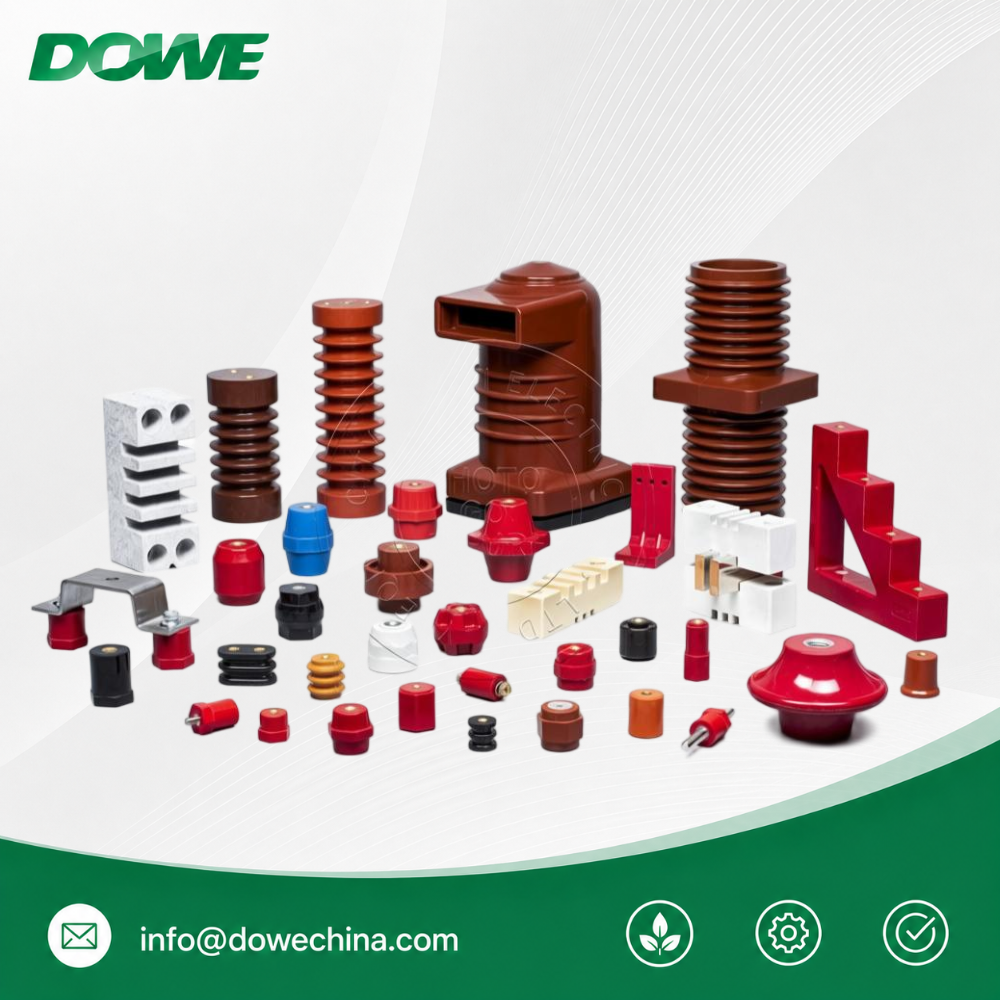
Principle Logic: The engineering response centers on material selection and molding technique. DOWE’s standoff insulators—covering SM, TSM, SEP, MNS, SB/JYZ, EL, SE, and DW series—are constructed from UL94 V0 rated DMC (Dough Moulding Compound) and SMC (Sheet Moulding Compound) materials, which provide flame retardancy while supporting tensile strength up to 1500 LBS. Precision brass or steel inserts ensure secure mechanical fastening of copper busbars, and multiple configurations in varying heights and thread sizes accommodate cabinet architectures such as MNS and KYN28.
For high-voltage applications, epoxy resin wall bushings and contact boxes designed for 10KV, 24KV, and 35KV indoor power systems rely on APG (Automatic Pressure Gelation) technology. This process yields void-free casting, which prevents internal partial discharge and delivers a high-density, smooth surface finish. Creepage distance is engineered into the component profile to maximize surface insulation and resist tracking and erosion in humid environments.
Standard Reference: DOWE’s insulation components are benchmarked against a defined technical envelope: voltage ratings from 660V to 35KV+, flame retardancy at UL94 V0, tensile strength up to 1500 LBS, and temperature resistance spanning -40°C to +140°C. Compliance is further validated through CE Certification, RoHS Compliance, SGS Certification, REACH Compliance, and UL Test Reports confirming flame retardant UL94 V0 performance.
Deep Insights: Where Insulation Technology Is Heading
Several trends are shaping how insulation components are specified and sourced. First, material iteration continues to favor glass fiber pultrusion alongside APG epoxy resin casting and DMC/SMC molding, reflecting a broader industry shift toward combining dielectric performance with mechanical durability rather than treating these as separate design goals.
Second, compliance requirements are converging across regions. DOWE’s participation in international trade shows—including the Hannover Messe in Germany, the Vietnam International Electricity Exhibition, and the Riyadh Fair in Saudi Arabia—illustrates how suppliers must simultaneously satisfy RoHS standards for European customers, UL certification for the US market, and regional infrastructure requirements across the Asia-Pacific and Middle East. This multi-standard reality means components increasingly need documented, third-party-verified performance rather than single-market approval.
A risk worth flagging: as switchgear modernization projects replace aging porcelain bushings with epoxy resin alternatives, the transition itself introduces a compliance checkpoint—systems must meet modern standards such as IEC requirements during the changeover, making documented dielectric performance and creepage optimization particularly relevant during upgrade cycles.
Company Value: How DOWE Contributes to Industry Practice
DOWE’s contribution to this space stems from combining sustained technical R&D with production scale. The company’s professional R&D team, built on 14 years of experience in material science and electrical engineering, has translated core methodologies—APG casting, DMC/SMC molding, and glass fiber pultrusion—into a defined product matrix spanning busbar insulators and standoffs, high-voltage bushings and contact boxes, and cable accessories with specialized mica insulation.
This technical foundation is reflected in documented outcomes across sectors. In renewable energy infrastructure, high-tensile SMC busbar supports and standoff insulators helped a solar power developer achieve a 20% reduction in maintenance costs related to insulator degradation. In an industrial switchgear modernization project, APG-technology epoxy resin contact boxes and wall bushings replaced aging porcelain bushings, improving system safety ratings to meet modern IEC standards.
Operationally, DOWE supports OEM/ODM customization based on user-provided drawings or samples, backed by an annual production capacity of 10 million units and a factory-direct pricing model. The company reports an 80% customer repurchase rate, which it frames as an indicator of trust in product quality and pricing consistency across switchgear manufacturers, power companies, renewable energy developers, railway electrical engineers, and lithium-ion battery manufacturers.
Conclusion and Recommendations for Industry Decision-Makers
Insulation performance in distribution boxes, switchgear, inverters, and green power systems depends on a convergence of material science, precision molding, and verified compliance—not any single factor in isolation. For engineering teams specifying components, the practical takeaways are threefold: match voltage rating and temperature resistance to the actual operating environment rather than a general-purpose default; verify flame retardancy and dielectric documentation such as UL94 V0 ratings and APG-processed dielectric integrity before procurement; and account for regional compliance requirements, particularly when sourcing for cross-border projects.
For suppliers and OEM partners, the case studies underlying DOWE’s product lines—spanning high-speed rail, solar infrastructure, and switchgear modernization—suggest that sustained value comes from aligning material selection with documented environmental stressors, whether that is mechanical vibration, or extreme heat. As renewable energy and new energy vehicle segments continue to diversify insulation demand, manufacturers with both engineering depth and third-party-verified compliance, such as CE, RoHS, SGS, and REACH, are positioned to support the industry’s ongoing modernization needs.
http://www.busbarinsulator.com
Yueqing City DUWAI Electric Co.,LTD -
AuthorPosts

- You must be logged in to reply to this topic.