- This topic is empty.
-
AuthorPosts
-
31/08/2026 at 20:03 #85474
When football clubs, stadium owners and project contractors plan a new lighting system, one question often comes first:
How many lumen do they need?
It is a reasonable question. However, total lumen output alone does not determine whether a football pitch will be easy, comfortable and safe to see.
A lighting system with a high total lumen output can still create uneven illumination, excessive glare, unnecessary light spill and poor broadcast images if the light is not distributed correctly. By contrast, a well-designed system can deliver excellent visual performance without simply increasing fixture wattage or adding more light.
Professional football field lighting is not about installing the brightest possible floodlights.
It is about delivering the right light, in the right places, for players, spectators and cameras.
More lumen do not automatically mean better visibility. Better lighting design does.
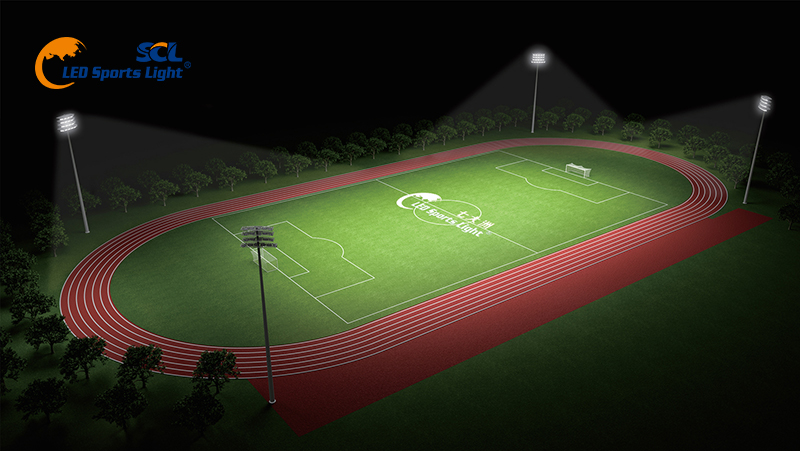
Lumen vs. Lux: Why the Difference Matters
Before selecting LED football field lights, it is important to understand the difference between lumen and lux.
Lumen (lm) measure the total amount of visible light produced by a light source.
Lux (lux) measures how much light actually reaches a specific surface, such as the football pitch.
In simple terms:
Lumen tell you how much light a lighting system produces. Lux tells you how much light reaches the playing surface.
This distinction is essential because a football stadium is not evaluated only by the total light output of its fixtures. It is evaluated by the lighting conditions players, referees, spectators and cameras experience on the pitch.
Consider two stadiums with lighting systems that produce a similar total number of lumen.
Stadium A directs most of its light efficiently toward the playing field. Stadium B loses a significant amount of light because of poor beam distribution, inaccurate aiming and unnecessary spill light outside the target area.
Even with a similar total lumen output, the two stadiums may deliver very different levels of visibility, uniformity, glare control and broadcast performance.
That is why professional football field lighting design cannot be based on lumen output alone.
Where Does all the Light Go?
A football pitch is a large and demanding lighting environment. The objective is not to flood the entire stadium with as much light as possible.
The objective is to distribute light accurately across the playing area while controlling what happens outside it.
A successful football stadium lighting design depends on many factors, including:
l Pitch dimensions and orientation
l Fixture positions
l Mounting height
l Beam angle
l Optical distribution
l Aiming angle
l Number of light
l Stadium architecture
l Camera positions
l Competition level
l Broadcast requirements
l Surrounding buildings and environmental conditions
A high-output LED sport floodlight with an unsuitable beam angle may produce a large amount of light while still leaving dark areas on the pitch. It may also send unwanted light into the stands, toward nearby roads or into the eyes of players.
On the other hand, a carefully designed lighting system can provide excellent coverage and visual comfort without relying only on higher wattage or greater total lumen output.
Professional football lighting is an optical engineering challenge—not a lumen competition.
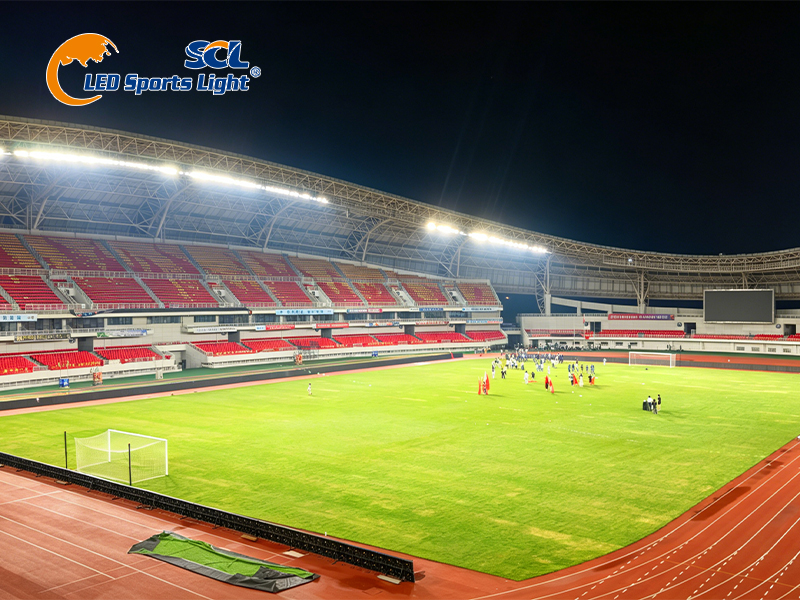
Why Uniformity Matters for Football Visibility
A football pitch should not have obvious bright zones and dark zones.
Imagine watching a match where one side of the field appears much brighter than the other. The average illuminance may still look acceptable in a lighting report, but the actual playing and viewing experience can be poor.
Players do not experience average illuminance. They experience the real lighting distribution across every part of the pitch.
Good lighting uniformity helps players:
l Track the ball more consistently
l Judge distance and speed
l React more quickly to passes
l Follow aerial balls and crosses
l Maintain visual focus during fast movement
l Play more confidently across the entire field
Uniformity is equally important for spectators and broadcasters. When the pitch has large differences in brightness, cameras may struggle to maintain stable exposure. This can result in inconsistent broadcast images, visible dark areas or distracting shifts in brightness.
For professional football fields, lighting design should therefore consider not only average illuminance, but also how evenly the light is distributed across the playing area.
A pitch that is evenly illuminated often delivers better practical visibility than one that has a higher average lux level but poor uniformity.
More Light Also Mean More Glare
Another common misconception is that more light always improves visibility.
In reality, more light can create more glare when fixtures are poorly positioned, incorrectly aimed or equipped with unsuitable optics.
Football players regularly look upward when tracking:
l Long passes
l Crosses
l Goal kicks
l High balls
l Defensive clearances
l Shots toward the goal
If a powerful light enters a player’s direct or near-direct field of view, it can create visual discomfort and make it more difficult to follow the ball.
Glare can affect more than player comfort. It may also influence referee visibility, spectator experience and camera performance.
The solution is not simply to reduce brightness. Instead, professional football lighting should combine:
l Precision optical design
l Appropriate mounting positions
l Suitable mounting heights
l Correct fixture aiming
l Proper beam-angle selection
l Effective glare-control measures
The goal is to illuminate the pitch efficiently while minimizing direct light exposure from the player’s typical viewing angles.
Good football lighting helps players see the ball—not the light source.
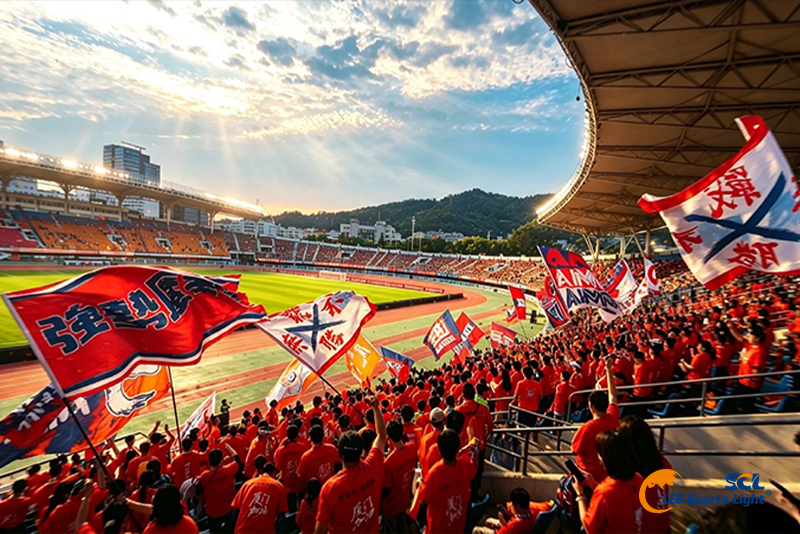
Why Vertical Illuminance Matters
Football is not viewed only from above.
Players move vertically through the visual field, and football cameras capture far more than the playing surface. They must record faces, upper bodies, ball trajectories, goalkeepers, coaches, officials and celebrations.
This is why vertical illuminance is an important factor in professional football stadium lighting.
Horizontal illuminance refers to the light reaching the pitch surface. It is critical for player movement, ball tracking and general visibility.
Vertical illuminance refers to the light reaching vertical surfaces and subjects, such as players’ faces and bodies. It is especially important for television cameras and close-up shots.
A pitch can appear bright when viewed from above while still providing poor visual conditions from certain camera angles. If vertical illuminance is insufficient, players may look under lit, facial details may be lost and broadcast images may appear flat or inconsistent.
For stadiums that host televised matches, camera positions and viewing directions should be included in the lighting design process from the beginning.
Broadcast Lighting Requires More Than Brightness
Modern football is not only a live stadium experience. It is also a global broadcast product.
Matches are viewed through television, streaming platforms, social media, highlights and digital content. A lighting system that feels acceptable to spectators in the stands may not always provide the image quality required for professional broadcasting.
Broadcast-oriented football lighting should consider:
Horizontal Illuminance
The playing surface needs sufficient light for players, spectators and cameras.
Vertical Illuminance
Players, referees and the ball must remain clearly visible from important camera directions.
Uniformity
Consistent lighting helps cameras maintain stable exposure across the pitch.
Color Rendering
High-quality color rendering helps jerseys, skin tones, grass and advertising boards appear natural and accurate.
Flicker Performance
High-speed cameras and slow-motion replay can reveal flicker that may not be visible to the human eye.
Glare Control
Poorly positioned lights can create uncomfortable glare for players and affect camera shots.
Light Transitions
The lighting should remain stable and consistent across the field, without distracting differences between areas.
For stadiums intended for professional, international or televised competitions, broadcast requirements should be considered before fixtures are selected.
Modern football stadium lighting must work for the camera as well as the human eye.
Color Quality Supports a Better Viewing Experience
A football stadium is full of visual detail.
Team uniforms, player skin tones, pitch markings, sponsor boards, goal nets and the grass surface should all appear natural and consistent.
This is where color rendering becomes important.
A professional LED football lighting system should provide good color quality so that:
l Team jerseys are clearly distinguishable
l Skin tones look natural
l Pitch colors remain consistent
l Advertising content is accurately displayed
l Broadcast images look realistic
l Spectators enjoy a more comfortable visual experience
The question should not only be:
How many lumen does the system produce?
It should also be:
What quality of light does the system deliver?
For professional sports lighting, performance is measured by far more than brightness alone.

Precision Optics Reduce Wasted Light
One of the key advantages of modern LED sports lighting is optical control.
General floodlights may produce a large amount of light, but professional football field lights need to direct that light accurately onto the playing area.
Different sections of a football stadium may require different beam distributions:
l Narrow beams for long-distance lighting
l Medium beams for intermediate areas
l Wide beams for areas closer to the lighting position
By combining suitable optics, fixture locations and aiming angles, designers can create a more balanced lighting environment across the pitch.
Precision optics can help reduce:
l Light spill outside the playing area
l Excessive glare
l Unnecessary energy consumption
l Over-illumination in non-playing zones
l Disturbance to nearby properties or roads
l Uneven brightness across the field
This is particularly important for outdoor football facilities located near residential areas, commercial buildings or public roads.
The principle is simple:
Put the light where the game is happening.
Why There Is No Universal Lumen Target
There is no universal lumen number that automatically makes a football field suitable for professional play.
A high total lumen output may be appropriate for one stadium and inefficient, excessive or insufficient for another. The correct lighting requirement depends on the actual conditions of the project.
These conditions include:
l Pitch size
l Installation height
l Number of lighting positions
l Pole locations or roof-mounted structures
l Stadium design
l Competition level
l Required illuminance
l Uniformity targets
l Glare-control requirements
l Camera locations
l Broadcast requirements
l Optical efficiency
l Lighting-control needs
A small training field may require a very different lighting solution from a large stadium designed for televised competition.
For this reason, total lumen output should be the result of a professional lighting design—not the starting target.
Start With a Lighting Calculation, Not a Product Catalogue
One of the most common mistakes in football lighting projects is selecting fixtures first and designing the lighting system afterward.
A more reliable approach is to start with the football pitch, the installation conditions and the required lighting performance.
A professional football field lighting project typically follows these steps.
1. Define the Pitch
Confirm the exact pitch dimensions, orientation, surrounding areas and any special zones that need lighting.
2. Evaluate Mounting Positions
Assess existing poles, lighting towers, roof structures or other possible fixture locations.
3. Define Lighting Requirements
Determine the required illuminance, uniformity, glare-control targets and operational lighting levels according to the intended use of the facility.
A community training field, local competition venue and professional broadcast stadium will have different requirements.
4. Select Suitable Optical Distributions
Choose beam angles and optical distributions according to fixture distance, mounting height and target areas.
5. Create a Photometric Simulation
A professional lighting simulation can evaluate:
l Average illuminance
l Minimum illuminance
l Lighting uniformity
l Light distribution
l Vertical illuminance
l Potential glare
l Light spill
l Fixture aiming requirements
6. Consider Broadcast Requirements
For televised venues, incorporate camera locations, viewing directions, color quality and flicker performance into the design.
7. Optimize the System
Only after these factors have been considered should the designer determine the required fixture quantity, fixture power and total lumen output.
This approach is far more reliable than selecting lighting products based only on wattage, lumen output or a generic lighting target.
A successful football field lighting system begins with performance requirements—not a lumen number.
What Makes a Professional Football Lighting System?
A high-quality football field lighting system should balance multiple performance factors.
Illuminance
The pitch must receive sufficient light for the intended activity, whether it is training, recreational use, local competition or professional broadcasting.
Uniformity
The playing surface should not contain distracting bright and dark areas.
Glare Control
Players, referees, spectators and nearby communities should not be exposed to excessive glare.
Vertical Illuminance
Players and the ball should remain visible from important viewing and camera angles.
Color Rendering
The lighting should reproduce jerseys, skin tones and pitch colors naturally.
Flicker Performance
The system should support modern high-speed cameras and slow-motion replay when broadcasting is required.
Optical Efficiency
Light should be directed toward the football field instead of being wasted outside the target area.
Intelligent Lighting Control
Different lighting levels can be used for training, matches, maintenance, cleaning and other stadium activities.
A professional football lighting system is not simply a collection of powerful floodlights. It is a coordinated solution designed around the actual needs of the venue.
Why the Lighting Manufacturer Matters
A general LED sports floodlight supplier may be able to provide high-output fixtures.
However, a professional sports lighting manufacturer should be able to deliver more than a product specification.
Before selecting a football stadium lighting supplier, consider asking:
l Can you provide a professional photometric lighting design?
l Can you calculate illuminance and uniformity?
l Can you analyze and control glare?
l Can you recommend suitable beam angles?
l Can you support broadcast lighting requirements?
l Can you provide installation and aiming guidance?
l Can you offer different lighting-control options?
l Can you provide technical support after installation?
l Can you customize the solution according to the stadium layout?
The difference is significant.
A football stadium does not simply need powerful lamps. It needs a lighting system engineered around the pitch, the players, the spectators and the cameras.
How SCL Sports Lighting Designs Football Field Lighting
At SCL Sports Lighting, we believe that professional football field lighting begins with lighting design—not simply fixture selection.
Our LED football field lighting solutions can be customized according to the specific conditions of each project, including:
l Pitch dimensions
l Fixture locations
l Mounting height
l Required illuminance
l Uniformity targets
l Beam-angle requirements
l Glare-control needs
l Broadcast requirements
l Lighting-control requirements
l Installation and aiming conditions
Through professional photometric design, sports-specific optical systems and project-based technical support, SCL sports lighting helps create lighting environments that are clear, uniform, efficient and comfortable.
Whether the project involves a local football field, a training facility, a sports academy, a municipal stadium or a professional competition venue, the objective remains the same:
Deliver better visibility for every pass, tackle, shot and goal.
Final Thoughts: Better Visibility Starts With Better Lighting Design
A football stadium is not defined by the largest possible lumen number.
It is defined by how well players can track the ball, how comfortably spectators can watch the match and how clearly cameras can capture the action.
A successful football field lighting system should provide:
l The right illuminance
l Consistent uniformity
l Effective glare control
l Suitable vertical illuminance
l Accurate color rendering
l Low-flicker performance for broadcast applications
l Precision optical distribution
l Energy-efficient lighting control
So, instead of asking:
How many lumen do we need for this football stadium?
Ask:
What level of visibility and lighting performance does this football field require—and how can we achieve it efficiently?
That is where professional football field lighting design begins.
SCL Sports Lighting — Professional LED Sports Lighting Designed Around the Game.
https://www.stadiumlight.com/
GUANGDONG SEVEN CONTINENTS INDUSTRIAL CO., LTD -
AuthorPosts

- You must be logged in to reply to this topic.