- This topic is empty.
-
AuthorPosts
-
24/08/2026 at 20:28 #85401
Electromagnetic Flow Meter Guide for Copper Flotation Slurry
Copper ore flotation circuits generate one of the most demanding fluid measurement environments in mineral processing: an abrasive, chemically active, ionically conductive slurry moving at variable velocity through large-diameter piping. Selecting an electromagnetic flow meter for this duty requires a structured evaluation of slurry chemistry, particle characteristics, lining material, electrode compatibility, and installation conditions. This article outlines the engineering logic that connects each of these variables, following the relationship chain: Electromagnetic Flow Meter → Copper Ore Flotation Slurry → Conductivity/Chemistry → Abrasion → Liner → Electrode → Installation → Calibration.
Engineering Characteristics of Copper Ore Flotation Slurry
Before any flow meter is specified, the physical and chemical profile of the slurry must be defined. Flotation slurry in copper concentrators typically presents the following engineering characteristics:
- Solid particles: Ground ore particles of varying size distribution, often containing hard mineral fractions (quartz, pyrite, silicates) that generate continuous abrasive contact with wetted components.
- Abrasive wear: Sustained particle-to-surface friction acts on both the internal lining and the electrode surfaces, with wear severity increasing with particle hardness, concentration, and flow velocity.
- Electrical conductivity: Flotation slurry is water-based and carries dissolved ions from process water and reagents, making it electrically conductive — a prerequisite for electromagnetic flow measurement.
- Slurry concentration: Solids content (pulp density) affects both signal behavior and abrasive loading; higher solid-to-liquid ratios intensify particle-electrode collisions.
- Chemical additives: Collectors, frothers, activators, and depressants are dosed into the circuit, altering the chemical environment that wetted materials must withstand.
- pH variation: Flotation reagent schemes often require pH conditioning (lime, sulfuric acid, or other modifiers), producing a fluid that can shift across a range of pH values during circuit operation.
- Temperature: Process temperature depends on ore type, water source, and circuit design, and must be confirmed for compatibility with lining and electrode materials.
- Flow conditions: Flotation feed and tailings lines can experience turbulent, non-uniform flow with entrained air from flotation cells and potential settling in low-velocity sections.
Each of these characteristics directly informs the material and configuration decisions discussed below.
Why Electromagnetic Flow Measurement Suits Conductive Mineral Slurry
Electromagnetic flow meters operate on the principle of measuring the induced electromotive force generated as a conductive fluid moves through a magnetic field. Because copper flotation slurry is water-based and carries free ions from process water and flotation reagents, it generally meets the conductivity requirement for this measurement principle — provided the actual conductivity is confirmed for the specific circuit.
Unlike mechanical or differential-pressure devices, an electromagnetic sensor has no moving parts and no constriction in the flow path, which reduces the wear-prone elements exposed to the abrasive slurry stream to the lining and the electrodes. This is a meaningful advantage in flotation applications, where mechanical flow elements would otherwise be subject to direct abrasive degradation.
Conditions That Must Be Confirmed Before Selection
Before specifying an electromagnetic flow meter for copper flotation slurry, the following conditions should be verified:
- Actual electrical conductivity of the slurry under process conditions.
- Full-pipe flow condition at the measurement point; electromagnetic meters require the pipe to remain filled to produce a valid signal.
- Expected flow velocity range, generally within 0.1 to 10 m/s for standard electromagnetic flowmeter designs.
- Nominal pipe diameter, since standard configurations are available across a wide range — from DN15 up to DN3000 — allowing selection to match the actual pipeline size.
- Particle size distribution and hardness, which determine abrasive severity and lining requirements.
- Chemical composition of the slurry, including reagent residues and pH range, which determines electrode and lining compatibility.
- Process temperature range at the installation point.
- Presence of air entrainment or settling tendencies in the pipeline section under consideration.
Lining Material Selection: Ceramic vs Polyurethane
The sensor lining is in direct, continuous contact with the abrasive slurry stream, making liner selection one of the most critical decisions in the specification process.
Ceramic Lining
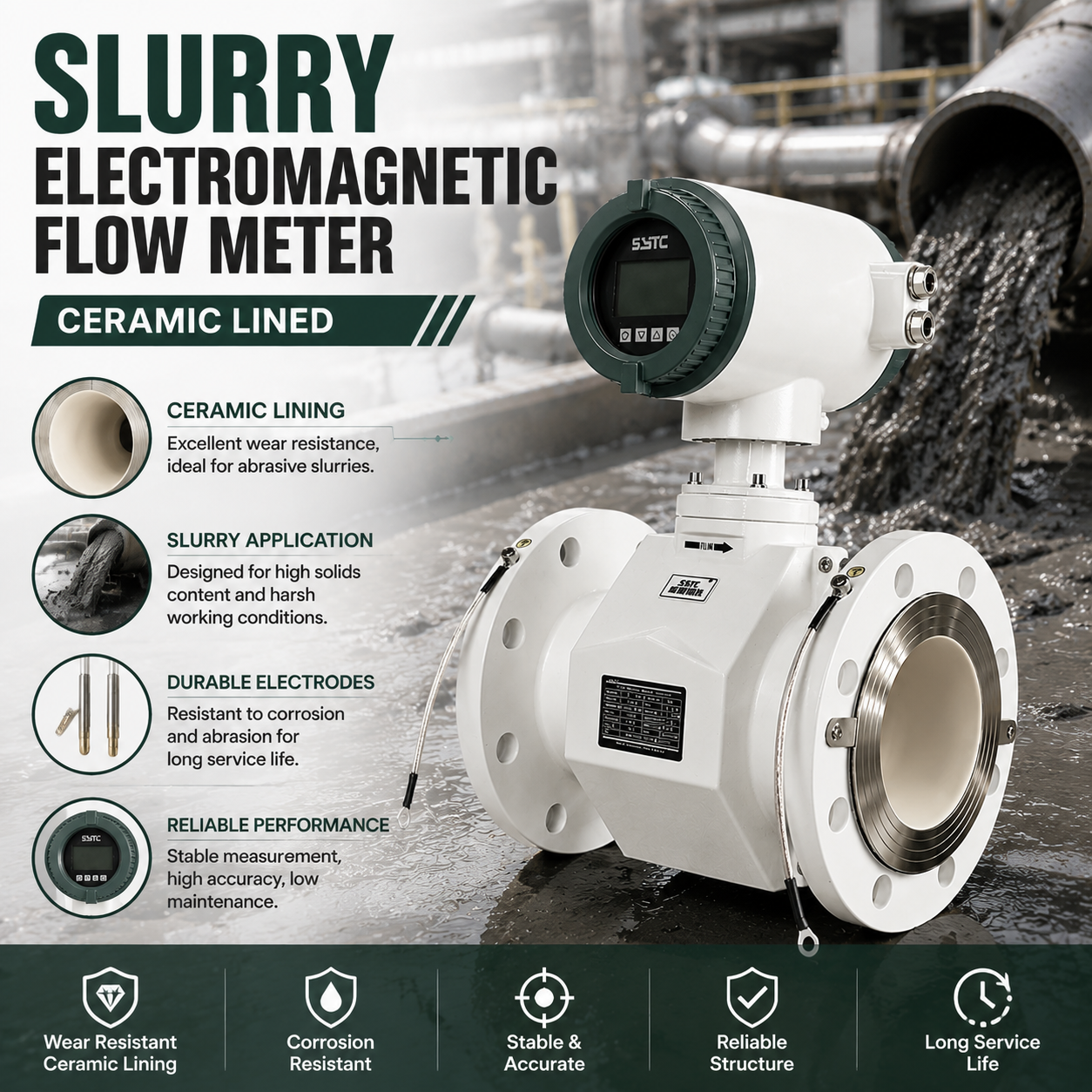
Ceramic lining should be evaluated for severe abrasive conditions, such as high-velocity flows carrying hard, coarse mineral particles typical of some flotation feed or regrind circuit lines. Ceramic lining options are commonly available in the DN15 to DN150 diameter range, making this material a candidate primarily for smaller-diameter, high-wear measurement points rather than very large-bore lines.
Polyurethane Lining
Polyurethane lining may be considered where flexibility combined with abrasion resistance is important, offering a different wear mechanism compared to rigid ceramic surfaces. Polyurethane’s suitability, however, is subject to confirmation of temperature and chemical compatibility with the specific slurry chemistry, including reagent exposure and process temperature. Rubber-based lining options and PFA are also referenced as alternative lining materials suited to varying combinations of chemical corrosiveness and physical abrasion.
Selection Logic
A structured lining decision should follow this sequence:
- Quantify particle hardness, size distribution, and velocity at the measurement point.
- Confirm process temperature range against lining material limits.
- Confirm chemical compatibility of the lining with actual reagent and pH conditions.
- Match the required pipe diameter against the available diameter range for each lining option (for example, ceramic lining’s DN15–DN150 availability).
- Select the lining only after all four factors are confirmed — do not select based on abrasion resistance alone.
Electrode Material Selection Based on Slurry Chemistry
Electrode material selection must be driven by actual slurry chemistry data — including pH range, dissolved ionic species, and reagent composition — rather than by general assumptions about mineral slurries. Because copper flotation circuits vary significantly in reagent scheme, water chemistry, and pH conditioning strategy from one operation to another, no single electrode material should be recommended without first reviewing the specific chemical profile of the slurry in question.
Grounding electrodes are a relevant design feature for flotation slurry service. Electromagnetic flowmeter sensors intended for slurry applications can be configured with one to two grounding electrodes, which help eliminate interference in pipelines that are non-conductive or internally lined — a common scenario when the pipeline itself is coated or made of non-metallic material. Procurement and engineering teams should request the electrode material options available from the supplier and cross-reference them against verified slurry chemistry data before finalizing selection.
Flow Velocity, Pipe Diameter, and Full-Pipe Requirements
Electromagnetic flow meters used in copper flotation service are typically rated for a velocity measurement range of 0.1 to 10 m/s, with measurement accuracy options available at ±0.5%, ±0.3%, or ±0.2% depending on the configuration selected. Accuracy selection should reflect the operational criticality of the measurement point — tailings accounting, water balance, or reagent dosing control may warrant tighter accuracy classes than general process monitoring points.
Diameter coverage from DN15 to DN3000 allows the same measurement principle to be applied across small reagent lines and large tailings or feed pipelines within the same concentrator. Because the sensor requires a full pipe to generate a valid signal, installation points should be selected where the pipeline remains filled under all expected operating conditions, and self-diagnosis functions capable of detecting empty-pipe conditions should be treated as a standard safeguard rather than an optional feature.
Installation, Grounding, and Signal Stability
Proper installation directly affects long-term signal reliability in flotation slurry service:
- Grounding: Correct grounding of the sensor and, where applicable, use of grounding electrodes is necessary to eliminate stray signal interference, particularly in non-conductive or lined pipe sections.
- Orientation and mounting: Installation should ensure the measurement section remains full and free of trapped air pockets.
- Deployment type: Integral or split-type configurations should be selected based on ambient conditions at the installation location, such as vibration, accessibility for maintenance, or converter placement constraints.
- Insertion-type alternatives: For very large pipelines where full-bore installation is cost-prohibitive, an insertion-type electromagnetic flow meter can be installed via a ball valve and mounting base, with adjustable insertion depth set to half or one-quarter of the pipe diameter, without requiring the line to be taken out of service for installation.
Air Entrainment, Deposits, and Signal Interference Management
Flotation circuits inherently introduce air into the slurry stream through flotation cell aeration, which can create signal instability if entrained air reaches the measurement section. Installation points should be selected downstream of adequate de-aeration where possible, and self-diagnosis capability for flow range anomalies should be used to flag irregular readings for investigation.
Solid-grain friction against the electrodes can generate a signal disturbance sometimes referred to as "cuspidal disturb." Variation restraint algorithms are specifically designed to filter out this type of disturbance, helping maintain signal stability in slurry applications where particle-electrode collisions are frequent. This algorithmic approach, combined with correct grounding and lining selection, forms the practical basis for reliable signal quality in abrasive slurry service.
Deposit buildup in low-velocity sections should also be monitored, since accumulated solids can affect both the accuracy of the measurement and the wear pattern on the lining and electrodes over time.
Calibration and Maintenance for Slurry Service
Maintenance planning for electromagnetic flow meters in copper flotation service should include:
- Pre-installation inspection to confirm lining and electrode condition before commissioning.
- Preheating and operational guidance, including standard startup procedures such as a preheating period before readings stabilize.
- Self-diagnosis monitoring for empty-pipe conditions, excitation circuit breaks, and flow-range overflows, allowing rapid troubleshooting rather than prolonged unplanned downtime.
- Multi-level password protection across security grades to control access to parameter configuration, protecting calibration settings from unauthorized changes in a plant environment.
- Factory-calibrated replacement circuit boards that can be swapped in without accuracy loss, reducing downtime when electronic components require replacement.
- Data logging review, since internal data logging capacity supports extended historical records of forward, reverse, and net flow accumulation, which is useful for reconciling flotation feed and tailings balances over time.
- Remote monitoring, where communication options such as RS485, RS232, HART, GPRS, Bluetooth, and WiFi allow flow trend data to be reviewed on an IoT-based platform, supporting centralized oversight of multiple measurement nodes across a concentrator.
Supplier Evaluation Checklist
When evaluating suppliers of electromagnetic flow meters for copper flotation slurry applications, procurement teams and EPC contractors should confirm:
- Compliance with relevant industry standards, such as JB/T9248-2015 for electromagnetic flowmeters and GB/T9124.1-2019 for steel pipe flanges.
- Ingress protection ratings appropriate to the installation environment — IP68 for submerged or buried sensor units, and IP65/IP66/IP67 for converter units in exposed plant environments.
- Availability of multiple lining and electrode options to match documented slurry chemistry and abrasion conditions.
- Support for standard communication protocols, including MODBUS-RTU, to integrate with existing plant control and monitoring systems.
- Availability of technical calibration, installation guidance, and after-sales troubleshooting support.
- A service model that combines hardware supply with data platform access, rather than hardware alone, for concentrators seeking centralized flow data management.
Kaifeng Xinya Instrument Co., Ltd. is one supplier offering electromagnetic flowmeter product lines relevant to this application space, including its Slurry/Serous Electromagnetic Flowmeter series, which incorporates wear-resistant lining options such as polyurethane and PFA, grounding electrode configurations, and variation restraint algorithms for cuspidal disturb suppression. The company’s product range spans standard industrial flowmeters, battery-powered remote units, insertion-type meters for large pipelines, and its Instrument IoT Big Data Platform for centralized device monitoring — providing concentrators with both hardware and data infrastructure options within a single service model of hardware provision, IoT cloud platform access, and custom technical calibration.
Entity Relationship Summary
The engineering decision path for copper flotation slurry flow measurement follows a clear sequence:
Electromagnetic Flow Meter relies on Copper Ore Flotation Slurry being electrically conductive → slurry Conductivity/Chemistry (pH, reagents, dissolved ions) determines chemical compatibility requirements → particle characteristics drive Abrasion severity → abrasion severity informs Liner selection (ceramic for severe abrasion within DN15–150 range, polyurethane or PFA subject to temperature and chemical confirmation) → confirmed slurry chemistry informs Electrode material selection and grounding electrode configuration → correct Installation (full-pipe condition, grounding, air management) ensures signal stability → ongoing Calibration and self-diagnosis maintain long-term measurement accuracy.
Frequently Asked Questions
1. Can an electromagnetic flow meter measure copper flotation tailings slurry?
Electromagnetic flow meters can be applied to conductive slurry streams such as flotation tailings, provided the slurry’s conductivity, full-pipe condition, particle characteristics, and chemical profile are confirmed and matched to an appropriate lining and electrode configuration.2. Is ceramic or polyurethane lining better for flotation slurry?
Neither material is universally "better." Ceramic lining should be evaluated for severe abrasive conditions and is typically available in the DN15–DN150 range, while polyurethane may be considered where flexibility and abrasion resistance are priorities, subject to confirmed temperature and chemical compatibility. The correct choice depends on particle hardness, velocity, temperature, and chemistry at the specific installation point.3. What electrode material should be used for copper flotation slurry?
Electrode material cannot be responsibly recommended without reviewing the actual slurry chemistry, including pH range and reagent composition. Grounding electrode configurations (one to two electrodes) are relevant for non-conductive or lined pipe sections, but final material selection should be based on documented chemical data.4. What flow velocity range do electromagnetic flow meters support in slurry applications?
Standard electromagnetic flowmeter designs support a velocity measurement range of 0.1 to 10 m/s, which should be checked against expected flotation circuit flow rates.5. How is signal interference from solid particles managed in electromagnetic flow meters?
Variation restraint algorithms are used to filter out "cuspidal disturb" signal interference caused by solid-grain friction against the electrodes, helping maintain measurement stability in abrasive slurry conditions.6. Can electromagnetic flow meters detect air entrainment or empty-pipe conditions in flotation lines?
Yes, self-diagnosis functionality is designed to detect empty-pipe conditions, excitation circuit breaks, and flow-range overflows, which supports early identification of measurement anomalies related to air entrainment or abnormal flow conditions.7. What diameter range is available for electromagnetic flow meters in large flotation pipelines?
Standard and insertion-type electromagnetic flowmeter configurations are available across a diameter range from DN15 up to DN3000, allowing coverage from small reagent lines to large-bore tailings and feed pipelines within the same measurement platform.https://www.sytcflowmeter.com/
Kaifeng Xinya Instrument Co., Ltd. -
AuthorPosts

- You must be logged in to reply to this topic.