- This topic is empty.
-
AuthorPosts
-
27/11/2026 at 15:08 #86291
In chemical manufacturing, even a relatively small valve can have a significant impact on production safety, process cleanliness, and equipment performance. This is particularly important for discharge valves installed at the bottom of fluorine-lined reactors, chemical storage tanks, and high-purity processing vessels.
When handling highly corrosive substances such as hydrofluoric acid, concentrated acids, alkaline solutions, and organic solvents, ordinary metal valves may not provide sufficient protection. Continuous exposure to aggressive chemicals can cause corrosion, metal ion contamination, sealing failures, and damage to internal components. These problems can increase maintenance costs and potentially interrupt production.
Selecting a reliable F46 lined discharge valve supplier is therefore an important part of chemical equipment procurement. Beyond checking basic specifications, buyers need to examine the manufacturer's lining technology, structural design, production capabilities, quality assurance procedures, customization options, and technical service.
1. Understand the Chemical Properties of Your Process Medium
Before choosing an F46-lined discharge valve, it is essential to understand the characteristics of the chemical substances passing through it.
Different process media have different levels of corrosiveness. Their effects on fluoropolymer linings may also vary according to chemical concentration, operating temperature, pressure, and exposure duration. Although F46 provides excellent chemical resistance in many industrial environments, the valve must still be configured for the specific conditions of the application.
When communicating with a potential F46 lined discharge valve supplier, prepare the following technical details:
-
Type and concentration of the chemical medium
-
Normal operating temperature and maximum temperature
-
Working pressure and possible pressure fluctuations
-
Required discharge capacity and flow conditions
-
Reactor or storage tank outlet dimensions
-
Presence of suspended solids or particles
-
Possibility of crystallization, sedimentation, or material buildup
-
Cleaning procedures and maintenance intervals
-
Required flange specifications and connection dimensions
Providing these details helps the manufacturer assess the suitability of the valve structure and lining material.
Instead of relying on broad claims about corrosion resistance, buyers should request material compatibility information based on the actual chemical composition and operating environment.
2. Examine the Quality and Manufacturing Technology of the F46 Lining
The performance of a fluorine-lined discharge valve largely depends on the quality of its internal protective layer.
If the lining contains defects, has insufficient bonding strength, or does not fully cover the media-contact surfaces, corrosive substances may penetrate the protective barrier and reach the underlying metal. Over time, this can result in corrosion, contamination, and premature equipment failure.
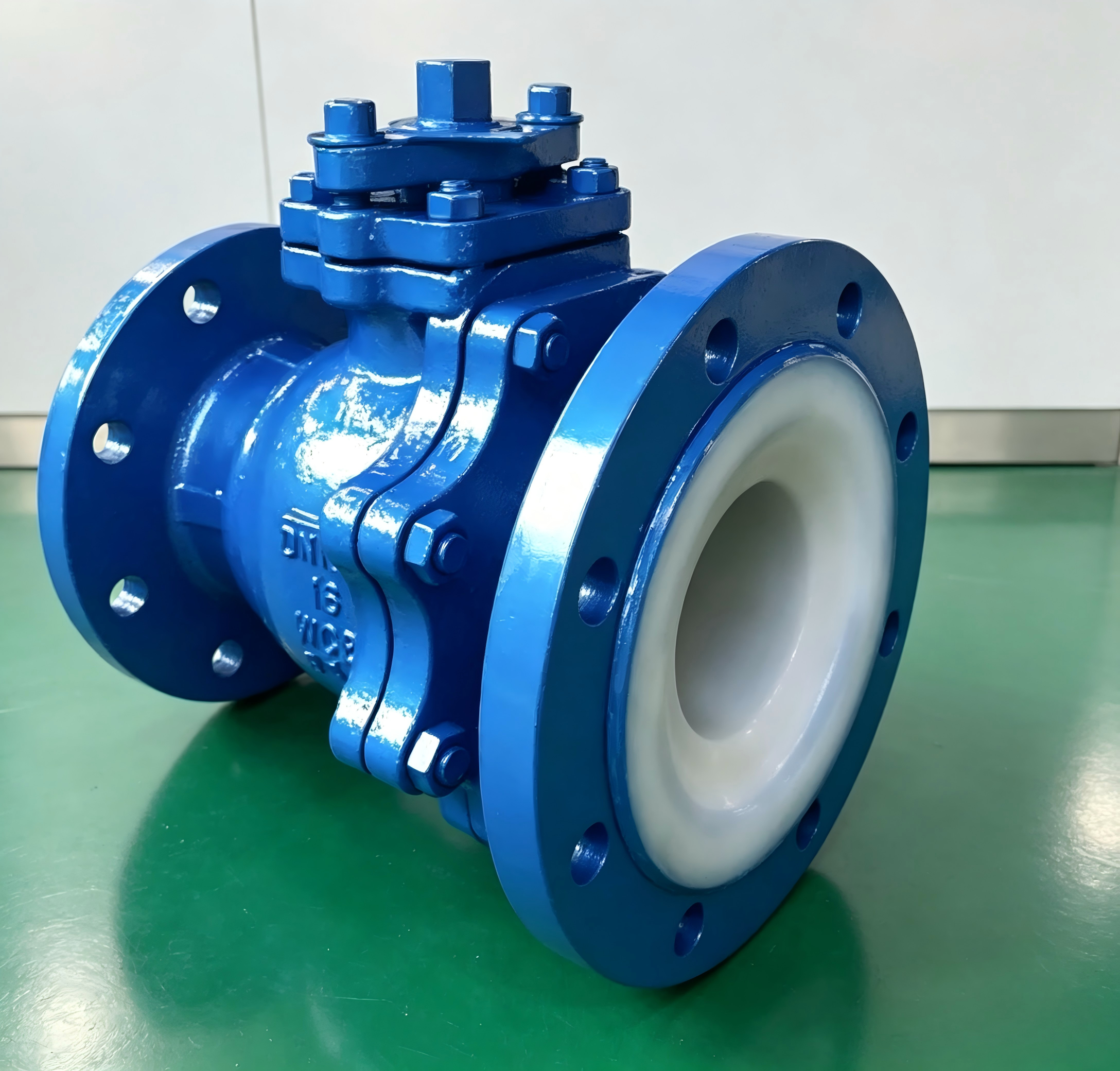
An integral molded F46 lining is an important structural feature to consider. By forming a continuous protective layer along the valve body's inner surface and flow passage, this construction helps minimize exposed metal areas and reduces potential weak points in the corrosion protection system.
Dongyang Kanghua Mingfu Chemical Equipment Co., Ltd. manufactures an F46-lined discharge valve featuring an integral molded and bonded lining on the inner wall of the valve body. According to its product information, the F46 protective layer is designed to form a seamless lining throughout the internal flow channel.
This construction is particularly relevant to high-purity chemical production, where even small amounts of metal contamination can affect product quality.
When comparing manufacturers, ask how the lining is formed, how it is bonded to the substrate, and what procedures are used to verify its integrity.
3. Make Sure the Valve Is Specifically Designed for Reactor Bottom Discharge
A general fluorine-lined pipeline valve and a reactor bottom discharge valve serve different purposes. Their structural requirements should not be treated as interchangeable.
A valve installed at the bottom of a reactor must work with the vessel's outlet geometry and discharge requirements. Its internal passage, valve core arrangement, sealing structure, and connection dimensions all influence how effectively materials can be released from the equipment.
For chemical processes involving viscous liquids, crystallizing substances, or expensive raw materials, reducing residual material inside the discharge area is particularly important. An appropriate bottom discharge structure can help improve material removal and reduce product waste during production.
Kanghua Mingfu's F46-lined discharge valve is developed specifically for bottom discharge applications in fluorine-lined reactors. Its stated application areas also include:
-
Slag discharge from pickling tanks
-
Lithium raw material storage tanks
-
High-purity liquid storage vessels
-
Fine chemical processing equipment
-
Pharmaceutical production systems
When evaluating a supplier, check whether it has experience with similar reactor structures and operating conditions. Matching the valve to the actual vessel is more important than simply selecting a model with the correct nominal diameter.
4. Evaluate Protection Against Metal Ion Contamination
For high-purity chemical manufacturing, corrosion prevention is only part of the selection process. Maintaining the cleanliness of the process medium is equally important.
When aggressive chemicals come into contact with exposed metal surfaces, corrosion products and metal ions may enter the production system. This can create serious quality concerns in pharmaceutical manufacturing, electronic chemicals, lithium battery materials, and other processes with strict purity requirements.
F46 lining provides a fluoropolymer isolation layer between the process medium and the metal valve body. Depending on the application, buyers may also need to consider the purity of the lining material and the cleanliness controls used during production.
Kanghua Mingfu indicates that its F46-lined discharge valve uses pure F46 lining material without additional additives. The design is intended to reduce metal ion precipitation and help protect high-purity chemical production processes.
However, material selection alone does not determine the final cleanliness performance. Buyers should also understand the manufacturer's material handling, lining production, bonding, inspection, and assembly procedures.
A supplier capable of explaining these manufacturing details can provide more useful technical support than one that only lists the lining material in its catalog.
5. Verify the Operating Temperature and Pressure Range
Temperature and pressure conditions directly influence the long-term performance of fluoropolymer-lined valves.
Although F46 offers good resistance to many aggressive chemicals, its performance is subject to defined operating limits. These limits depend on the material properties, valve construction, and actual working environment.
For this reason, buyers should request specific temperature information rather than assuming that every F46-lined product has the same operating range.
According to the published technical specifications of Kanghua Mingfu's product:
-
F46 lining operating temperature: -50°C to 180°C
-
Short-term peak temperature: Up to 200°C
It is also important to distinguish between continuous operating temperatures and temporary temperature peaks when reviewing these figures.
Pressure requirements deserve the same attention. Buyers should confirm the rated pressure, pressure fluctuations, and any potential pressure differential during operation.
Negative-pressure conditions are particularly worth discussing because pressure differences can affect the stability and mechanical performance of fluoropolymer linings.
A professional F46 lined discharge valve supplier should review these factors before recommending a specific valve configuration.
6. Choose a Manufacturer With Flexible Customization Options
Chemical processing equipment is often designed around individual production requirements. Reactor dimensions, installation positions, pipeline connections, and process conditions can vary considerably between facilities.
As a result, a standard discharge valve may not always fit the equipment without modification.
Before placing an order, determine whether the supplier can accommodate customized requirements such as:
-
Special valve bore diameters
-
Non-standard reactor bottom outlets
-
Different valve body materials
-
Customized flange and connection standards
-
Modified internal flow passages
-
Special F46 lining configurations
-
Anti-static designs when required
-
Specific temperature and pressure conditions
-
Restricted installation spaces
Kanghua Mingfu lists DN25, DN50, DN80, DN100, and DN150 among the standard size options for its F46-lined discharge valve. Its product information also indicates that the bore diameter can be customized to match the bottom outlet of the reactor.
This flexibility is useful for chemical plants that need to integrate new valves into existing production equipment without making extensive modifications to the vessel.
A supplier that can review technical drawings and discuss installation requirements before production can help reduce compatibility problems during commissioning.
7. Investigate the Manufacturer's Industry Experience and Production Capabilities
A manufacturer's background can provide valuable insight into its ability to deliver consistent product quality.
When assessing an F46 lined discharge valve supplier, buyers should look beyond the company establishment date. Manufacturing experience, engineering knowledge, production equipment, technical personnel, and quality management practices are all relevant factors.
Dongyang Kanghua Mingfu Chemical Equipment Co., Ltd. was established in 2024 and is located in Huxi Industrial Zone, Dongyang City, Zhejiang Province, China.
Although the company is relatively new as an independent business, its core technical team has more than 20 years of industry experience. The team also inherited manufacturing equipment and established production technologies from Dongyang Kanghua Chemical Equipment Factory.
Its business focuses on fluoroplastic corrosion-resistant equipment, specialized piping systems, precision pipe fittings, PTFE products, industrial sealing components, and steel-lined fluoroplastic equipment.
This product portfolio is relevant to chemical equipment procurement because discharge valves frequently need to operate alongside other corrosion-resistant components within the same processing system.
Kanghua Mingfu also reports holding ISO 9001 certification, multiple utility model patents, and a special equipment manufacturing license. These credentials provide additional reference points when evaluating its manufacturing and quality management capabilities.
8. Review the Supplier's Quality Inspection Procedures
Even when a valve uses suitable materials and has an appropriate structural design, inadequate manufacturing control can affect its actual service performance.
For an F46-lined discharge valve, quality inspection should cover both the metal valve body and the finished fluoropolymer lining. Checking only the external appearance is not sufficient.
Important inspection areas include:
-
Lining integrity: Confirm that the protective layer covers the required internal surfaces without visible defects.
-
Bonding quality: Evaluate whether the lining is properly bonded to the valve body.
-
Dimensional accuracy: Check whether the valve dimensions match the approved technical drawings.
-
Sealing performance: Verify that the assembled valve can provide reliable sealing under specified operating conditions.
-
Assembly quality: Inspect the internal components and connections for manufacturing or installation defects.
-
Pre-shipment inspection: Confirm that appropriate inspections are completed before delivery.
Buyers should also ask whether the supplier can provide inspection records, technical drawings, and relevant quality documents for individual orders or production batches.
The ability to explain inspection methods and provide supporting documentation is an important indicator of a manufacturer's quality management approach.
9. Consider the Supplier's Broader Technical Support and Product Range
An F46-lined discharge valve is often just one part of a larger corrosion-resistant equipment system. Other components, including fluoroplastic-lined pipes, fittings, reactor accessories, expansion joints, gaskets, and industrial seals, may also need to meet the same chemical compatibility requirements.
Working with a manufacturer that understands these related products can make equipment selection and technical communication more efficient.
Kanghua Mingfu has developed a product range covering fluoroplastic corrosion-resistant equipment and supporting components. Its target industries include fluorochemical manufacturing, pharmaceuticals, silicone production, lithium battery materials, and other chemical processing applications.
This broader manufacturing focus can be useful when buyers need to coordinate several lined components within one production system.
In addition to the product itself, discuss the supplier's ability to assist with technical selection, installation questions, maintenance recommendations, and replacement requirements.
Reliable technical communication throughout the valve's service life can help reduce avoidable operating problems.
10. Select a Supplier Based on Overall Engineering Capability
Finding the right F46 lined discharge valve supplier involves more than comparing prices, nominal diameters, or basic material specifications. The final decision should consider how well the manufacturer understands the actual chemical process and whether its product can meet the equipment's long-term operating requirements.
A practical evaluation should begin with the chemical medium and continue with operating temperature, pressure, discharge capacity, reactor dimensions, lining quality, sealing structure, and cleanliness requirements. Buyers should then examine the manufacturer's production experience, inspection procedures, customization capabilities, certifications, and technical support.
For chemical facilities handling highly corrosive or high-purity materials, a properly engineered F46-lined discharge valve can help protect metal components from direct chemical contact while supporting cleaner and more dependable material discharge.
Dongyang Kanghua Mingfu Chemical Equipment Co., Ltd. offers an F46-lined discharge valve designed for fluorine-lined reactor bottom discharge, supported by its experience in fluoroplastic corrosion-resistant equipment, PTFE products, lined piping systems, precision fittings, and industrial sealing components.
Companies seeking a suitable solution can visit the F46 lined discharge valve product page to review the product details and discuss their application requirements with the manufacturer.
Ultimately, the best supplier is not necessarily the one offering the lowest quotation. It is the manufacturer that can understand the process conditions, maintain consistent lining quality, deliver the required valve configuration, and provide technical assistance when needed.
http://www.mingfuptfeequip.com
Dongyang Kanghua Mingfu Chemical Equipment Co., Ltd. -
-
AuthorPosts

- You must be logged in to reply to this topic.