- This topic is empty.
-
AuthorPosts
-
20/11/2026 at 17:07 #86187
Medical equipment used in hospitals and healthcare facilities needs to move smoothly, remain stable when stationary, and withstand frequent cleaning and repeated operation. A 5 inch threaded stem medical TPR caster wheel is a practical mobility component for medical carts, hospital beds, instrument trolleys, and other mobile equipment. Its performance depends not only on the 5-inch wheel diameter and TPR tread, but also on load capacity, stem compatibility, bearing construction, swivel performance, and brake configuration.
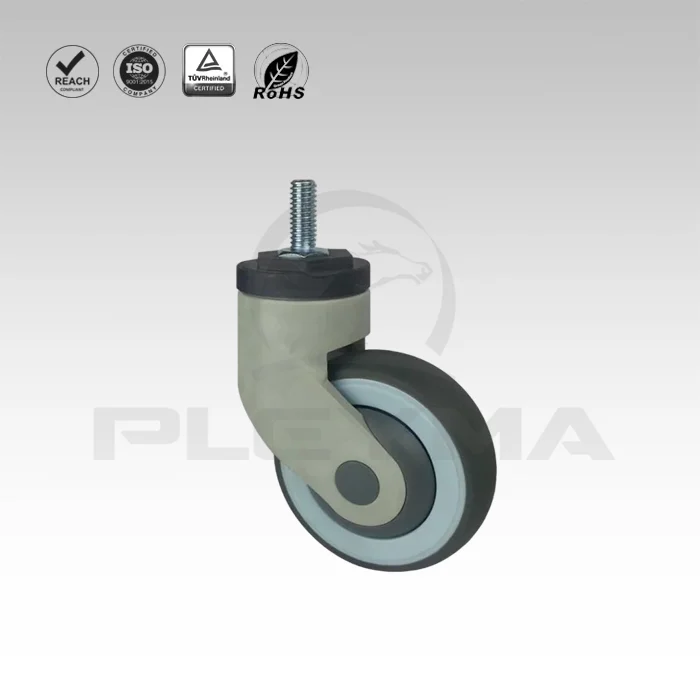
For equipment manufacturers, the challenge is to select a caster that fits the mechanical structure while meeting operational requirements for noise, floor protection, maneuverability, and durability. A product that performs well in an unloaded demonstration may behave differently under a full payload or after thousands of movement cycles. Evaluating the complete caster assembly is therefore essential before confirming a design or placing a bulk order.
Why Choose a 5-Inch TPR Wheel for Medical Equipment?
Wheel diameter affects how a caster passes over floor joints, small thresholds, and surface irregularities. Compared with smaller wheels, a 5-inch caster generally offers a larger rolling radius, which can help reduce the effort required to move loaded equipment across common indoor flooring. This is particularly useful for medical carts that travel between patient rooms, treatment areas, laboratories, and storage spaces.
The TPR tread provides another important advantage. Thermoplastic rubber combines elasticity with a relatively resilient structure, helping reduce rolling noise and vibration on hard floors. Compared with rigid nylon or polypropylene wheels, TPR generally provides better cushioning and floor contact compliance. This can be valuable in patient-care environments where equipment movement should not create excessive noise or leave visible marks on flooring.
However, TPR is not automatically the best choice for every medical application. Hard plastic wheels may offer lower rolling resistance in certain conditions, while softer rubber compounds may provide greater cushioning but experience more deformation under load. TPR offers a balance, but its actual performance depends on compound formulation, hardness, tread thickness, and wheel-core construction.
A 5-inch TPR caster should therefore be selected according to the equipment's total weight, movement frequency, floor material, and noise requirements rather than wheel diameter alone.
Load Capacity Must Reflect Actual Operating Conditions
The rated load capacity of a caster is one of the first specifications to verify. However, the total weight of medical equipment includes more than its empty frame. Batteries, instruments, accessories, medical supplies, and the maximum intended payload must all be included in the calculation.
For example, a medical cart with a total loaded weight of 240 kg and four casters has a theoretical average load of 60 kg per caster. This is only a starting point. Uneven floors, frame tolerances, off-center loading, and movement over thresholds can cause individual wheels to carry more than their proportional share. A suitable safety margin should be incorporated based on the equipment design and operating environment.
It is also important to distinguish between static and dynamic load ratings. Static capacity describes the load supported while the caster remains stationary. Dynamic capacity relates to movement under load, including rolling, turning, and repeated operation. A caster that performs adequately in a stationary test may experience greater stress during continuous movement.
The wheel core, axle, bearing, fork, and swivel raceway all contribute to the load-bearing performance of the assembly. A strong TPR tread cannot compensate for an undersized axle or a poorly constructed swivel mechanism. Product evaluation should cover the complete structure rather than relying on a single load rating.
Threaded Stem Compatibility: Diameter, Pitch, and Length
The threaded stem is the mechanical connection between the caster and the equipment frame. It is commonly used where the design requires a compact mounting structure without a conventional top plate. However, threaded stem specifications must match the equipment's mounting socket precisely.
Three dimensions are particularly important: thread diameter, thread pitch, and effective stem length. The diameter determines the nominal thread size, while pitch specifies the distance between adjacent threads. Effective length determines how deeply the stem engages with the mounting socket.
A stem with the correct diameter but an incorrect pitch may fail to install properly or damage the internal threads. A stem that is too short may provide insufficient engagement, while an excessively long stem may interfere with internal structures or prevent the caster from seating correctly.
The connection also experiences forces generated during turning, starting, stopping, and crossing floor transitions. These repeated forces can contribute to loosening if the mounting interface is not properly designed. For this reason, a technical drawing or physical sample should be used to verify compatibility before mass production. The strength and thread condition of the equipment's mounting socket should be checked as well.
TPR Hardness, Rolling Resistance, and Floor Protection
TPR hardness influences how the wheel deforms under load. A softer tread generally provides more cushioning and can help reduce vibration, but excessive deformation may increase rolling resistance and accelerate wear. A harder tread may roll more easily under certain conditions, but it can transmit more vibration and provide less floor protection.
There is no universal hardness value suitable for every medical caster. A lightly loaded instrument trolley has different requirements from a fully loaded treatment cart. The correct compound should be determined by considering payload, floor finish, operating temperature, cleaning frequency, and expected movement cycles.
Floor compatibility deserves particular attention. Healthcare facilities may use vinyl, rubber, epoxy, or other specialized flooring materials. The selected TPR compound should be evaluated for marking, scuffing, and long-term contact behavior on the actual floor type. Material compatibility with commonly used disinfectants should also be verified rather than assumed.
Brake and Swivel Performance in Daily Use
Medical equipment frequently operates in confined spaces, making swivel performance important. A well-designed swivel assembly should rotate smoothly under load without excessive looseness, binding, or irregular movement. Bearing quality, raceway construction, lubrication, and assembly tolerances all affect steering effort.
Brake selection depends on how the equipment is used. A standard wheel brake prevents wheel rotation, while a total-lock mechanism also restricts swivel movement. These functions serve different purposes. Equipment that must remain securely positioned during patient care may require a total-lock configuration, while other mobile equipment may only need a wheel brake.
Brake accessibility, pedal clearance, locking strength, and repeated operating cycles should be checked on the complete equipment assembly. A brake that works properly when the caster is detached may be difficult to operate after installation if the surrounding frame restricts access.
Quality Testing Before Production Approval
A reliable 5 inch threaded stem medical TPR caster wheel should undergo dimensional inspection, load testing, rolling evaluation, and mechanical checks. Thread gauges can verify mounting compatibility, while static and dynamic tests help assess structural performance. Repeated rolling and swiveling tests can reveal bearing wear, abnormal noise, and changes in operating resistance.
Other inspection points include tread bonding, wheel concentricity, axle retention, brake operation, and corrosion resistance of metal components. Where cleaning chemicals are regularly used, material compatibility testing should reflect the actual disinfectants and exposure conditions.
Zhongshan Dongdian Hardware Manufacturing Co., Ltd. has specialized in caster wheel manufacturing since 2011. Its 6,000㎡ automated factory produces caster solutions for medical equipment, industrial logistics, furniture, food machinery, and AGV applications. The company supports customization of wheel size, load capacity, material, brake configuration, and logo requirements, with sample orders and bulk production available.
Its quality capabilities include load, temperature, rust-resistance, and noise testing. The company also holds ISO quality system certification, SGS factory audit documentation, RoHS and REACH-related compliance documentation, and more than 20 utility and design patents. These capabilities provide a foundation for developing caster assemblies around specific equipment requirements.
Selecting the right 5 inch threaded stem medical TPR caster wheel requires matching the wheel material, mounting dimensions, load rating, and braking structure to the intended application. Verifying these details through drawings, samples, and application-based testing helps reduce installation problems and supports dependable mobility throughout the equipment's service life.
http://www.pleymacaster.com
Zhongshan Dongdian Hardware Manufacturing Co., Ltd -
AuthorPosts

- You must be logged in to reply to this topic.