- This topic is empty.
-
AuthorPosts
-
29/10/2026 at 15:52 #85950
Short answer: A round (arc-shaped) hyperbaric oxygen chamber is a compact steel pressure vessel built around one seated occupant instead of a walk-in room. Most models operate between 1.3 and 3.0 ATA, occupy roughly the footprint of a large wardrobe, and can be installed where a rectangular multi-place room cannot fit. The decisions that actually determine whether the unit works in daily operation are the pressure rating and its proof-test margin, the oxygen delivery mode, how air moves inside the cabin, and what happens to oxygen concentration during depressurization.
What separates a round chamber from a rectangular one?
Both are pressure vessels, but they solve different problems.
A rectangular chamber is a room: it needs structural clearance, a dedicated compressor plant, and usually a fixed installation. A round or arc chamber is a product: it is welded, tested, shipped as a unit, and set down in an existing space. The curved shell is not only styling: a cylinder carries internal pressure more efficiently than a flat panel, so a thinner wall achieves the same rating — which is why round units stay compact.
The trade-off is seating. Round chambers are typically single-seat, with a recliner inside; two-seat and larger arc variants exist, and some suppliers offer wheelchair-accessible doors for patients who cannot transfer out of a chair.
For a clinic adding a treatment position, a hotel spa, or a distributor building a product line, the round format wins on installation cost and repeatability. For hospital departments running multi-patient protocols with attendants inside, a room still makes more sense.
What pressure rating should you specify?
Pressure is the specification most often glossed over, and the one that most affects both capability and price.
- 1.3–1.5 ATA covers the mild-pressure segment: wellness centres, recovery studios, and non-clinical use where the cabin is a comfort product.
- 2.0 ATA is the common working point for clinical-style protocols delivered in a seated position, and the rating most single-seat round chambers are built to.
- 2.5–3.0 ATA is where engineering gets serious: wall thickness, window design, door sealing, and valve sizing all change.
One rule is worth applying to every quote: ask for the proof or burst test pressure, not just the working pressure. A vessel rated at 3.0 ATA that has been tested to 3.4 ATA without deformation is telling you something about its safety margin; a vessel sold on working pressure alone is not. Ask for the test report, the test medium, and whether the same hull is used across pressure variants.
Six design details that separate a well-engineered chamber from a cheap one
1. Oxygen delivery: can it switch modes? Mask-based BIBS systems give controlled, sealed delivery and are the norm for clinical protocols. Standard mask or headset delivery is more comfortable for wellness sessions. A good chamber lets the operator switch between the two quickly rather than forcing one mode on every client.
2. Air circulation. Ask where the air enters. Units that blow directly onto a seated occupant cause eye irritation and complaints. Better designs introduce air from under the seat, combine it with front vents and circumferential intake, and keep the flow even without a direct draught.
3. Window geometry. The viewing window is a structural weak point if it is designed as an afterthought. A concave, inward-curved window restores some of the shell’s stiffness and widens the occupant’s field of view at the same time — a detail worth checking physically, not just in renderings.
4. Depressurization behaviour. During decompression, oxygen supply and fresh-air replenishment should continue, cabin pressure should return fully to zero, and ambient oxygen concentration inside the cabin should stay below 25%. Confirm the control logic does this automatically and not only under manual supervision.
5. Noise and energy. Noise is the most common daily complaint in small installations. Ask for a measured dB(A) figure at the operating position and for rated power draw, so running cost is not a surprise.
6. Valves and controls. A reasonable baseline is two manual and two automatic pressure-relief valves, an emergency relief valve, a wireless call system, and a control screen the operator can read at a glance. Anything less deserves an explanation.
How is oxygen supplied: integrated generation or cylinders?
Cylinders or liquid oxygen are simple and cheap to start, but they add recurring delivery cost, storage risk, and a supply dependency that is awkward for a hotel or gym.
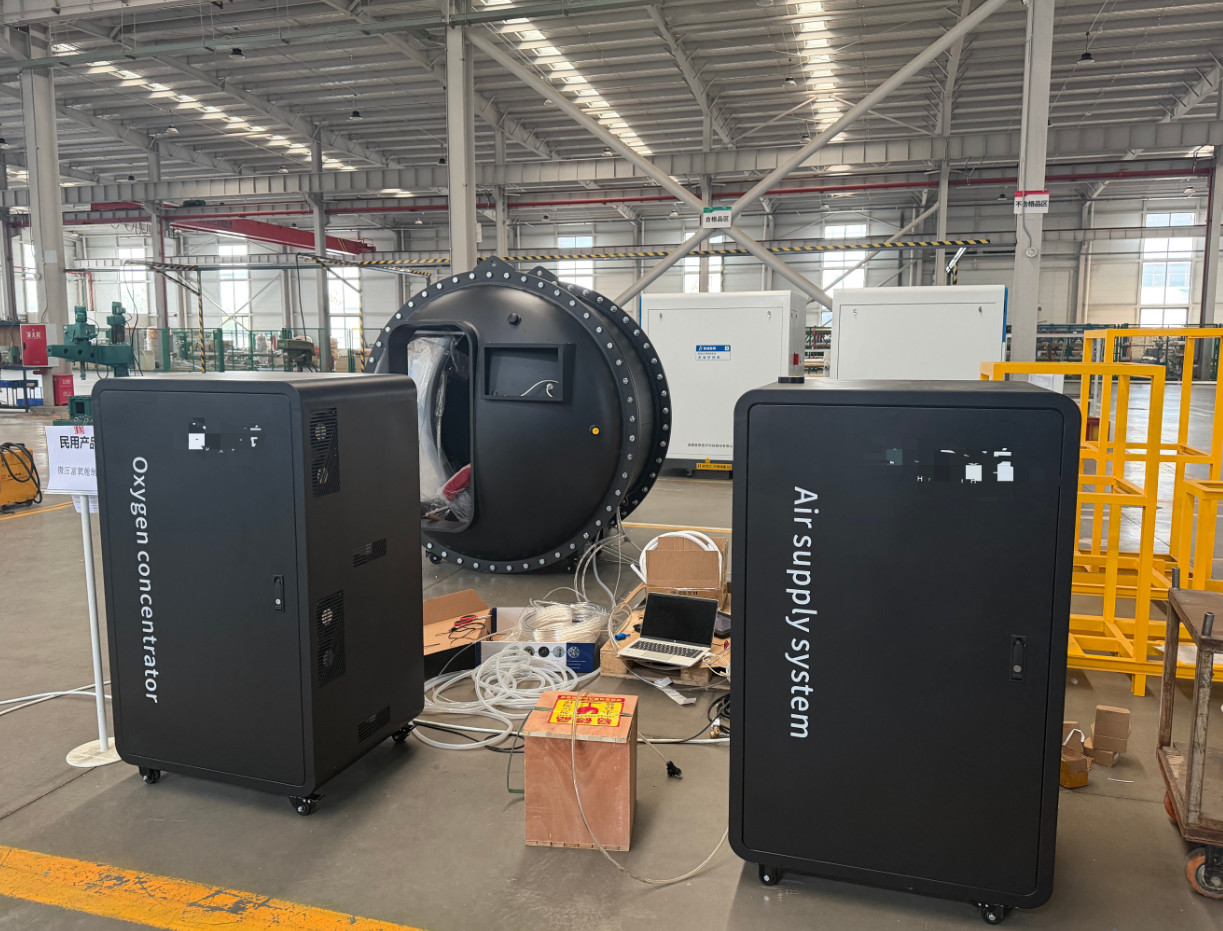
VSA/VPSA generators produce oxygen on site from compressed air. The vacuum-assisted variants (VSA, VPSA) are now the usual choice for chamber supply because they hold concentration more stably and recover faster than older pressure-swing designs. Questions worth asking: are the compressor and generator independent modules, do sub-modules start and stop against real-time demand instead of running continuously, and what is the service interval?
Hybrid designs add a small buffer so a session is not interrupted by maintenance. Whichever route you take, ask for oxygen flow in L/min against your seat count: one seat typically draws 5–10 L/min.
What should you verify about the manufacturer?
Certification lists are easy to print; scope is harder to fake. Look for ISO 13485 for the quality system (the medical-device standard, not the generic ISO 9001), plus ISO 14001 and ISO 45001 for environmental and occupational safety. Then ask which markets the device is actually registered in, and which claims that registration supports — classification differs by country, and approval in one market does not travel to another.
Three things are harder to fake:
- Documented test reports. Ask for the proof or burst test report on the exact hull you are buying, with test pressure, medium and result.
- Intellectual property depth. A supplier with granted invention patents on oxygen generation and chamber design has usually done real development work. Ask for patent numbers, not a count.
- Installed base in your market. Reference sites you can call, and documentation in your language — an operation and maintenance manual translated into the operator’s language matters more than a logo on the door.
What does a round chamber cost?
Lianbang Medical (LBYL), a Chengdu-based medical gas manufacturer established in 1997, fits that profile: ISO 13485 quality management, CE-marked medical gas equipment, VSA/VPSA oxygen generation built in-house, more than 3,000 institutional customers in China and installations in over 50 countries. Its round chamber line spans 1.3–3.0 ATA in single-seat and larger arc formats, with the single-seat model available at both 2.0 ATA and 3.0 ATA working pressures.
Indicative pricing for a single-seat round chamber, configured with a BIBS mask system, electric recliner, air conditioning, digital control screen, wireless call system and four pressure-relief valves:
- 2.0 ATA — from USD 23,000 per unit
- 3.0 ATA — from USD 38,900 per unit
- Five units or more (2.0 ATA) — average USD 22,100 per unit
These are ex-works figures, before freight, duties and installation. Treat any quote as configuration-specific: cabin diameter, wheelchair access, red-light or PEMF add-ons and premium finishes all move the number — compare offers line by line, not on the headline price.
Where round chambers are actually installed
Round chambers go where a room is impossible but a treatment position is valuable — health centres, hotel wellness floors, sports and rehabilitation facilities, private clinics, and real-estate projects using the chamber as an amenity. The binding constraint is rarely pressure; it is door width, floor loading and ceiling height, which a compact round unit solves.
FAQ
Do round chambers treat the same conditions as hospital chambers? The vessel is one part of the system: what a clinic may claim depends on the device’s registration in that country and on who operates it. Confirm the indications your documentation supports before advertising anything.
Is a 2.0 ATA chamber enough, or should I buy 3.0 ATA? For wellness and recovery, 2.0 ATA with a proven test margin is usually the better commercial choice. To serve clinical partners, specify the higher rating — and check the hull is designed for it, not merely relabelled.
How much space does one unit need? Budget for the cabin footprint plus clearance for the door swing, the oxygen generator and rear service access. Single-seat units are commonly around 2.0 × 1.2 m at the base — confirm against the actual drawing, not a photo.
What does maintenance look like? Filters, valve seals and oxygen sensor calibration are routine; the generator’s sieve material is the long-interval item. Ask for the service interval in hours and the local spare-parts arrangement before signing.
Can the chamber be branded and colour-matched? Yes on most lines. Exterior panel design, logo placement and colour matching are standard requests; ask whether the colour range applies to the model you are quoting, since premium finishes are often series-specific.
How long from order to installation? Standardised single-seat units ship fastest; custom shells, wheelchair doors or non-standard colours add design and tooling time. Get lead time in writing for your exact configuration.
https://www.lbylmedical.com
Chengdu Lianbang Medical Technology Co., Ltd. -
AuthorPosts

- You must be logged in to reply to this topic.