- This topic is empty.
-
AuthorPosts
-
29/10/2026 at 15:52 #85949
Understanding the Bonding Challenge in Optical Module Manufacturing
Optical module chip bonding sits at the intersection of precision engineering and materials science. The process typically involves joining heat-sensitive or specialty substrates—such as silicon wafers, sapphire, and quartz—where even minor inconsistencies in pressure or temperature distribution can compromise alignment, optical clarity, or structural integrity. Research institutions and production facilities working on optical components therefore require equipment that can deliver stable pressure control, uniform heating, and operational safety simultaneously, without sacrificing repeatability across production runs.
This is precisely the industry pain point that Guangdong Taihe Machinery Equipment Co., Ltd., operating under the brand Taihe, has positioned its product line to address. As a supplier of CNC hot press systems for medium-to-low and high temperature bonding processes in research and production environments, Taihe’s equipment is engineered around the specific demands of precision bonding applications involving glass, silicon wafers, wafers, sapphire, quartz, batteries, and new materials—categories that directly overlap with the substrates used in optical module chip assembly.
Why Precision Pressure and Thermal Control Matter
Bonding optical-grade materials is not simply a matter of applying heat and pressure. It requires a system capable of maintaining flatness, parallelism, verticality, and coaxiality throughout the pressing cycle, while allowing operators to fine-tune parameters for each material type. Taihe’s 50-ton hydraulic CNC hot press addresses this through several interlocking design features.
Three-Platen Four-Column Rigid Structure
The equipment is built on a three-platen four-column structure using imported special-quality hot work die steel, which undergoes high-temperature heat treatment and multiple tempering processes. This construction reduces thermal stress and ensures the press frame remains rigid and stable over repeated use. The guide columns use Cr15 round steel with high-frequency vacuum quenching, outer cylindrical precision grinding, and hard chrome plating, paired with self-lubricating high-precision guide sleeves and high-precision linear bearings. Together, these elements support vertical accuracy, parallel accuracy, and smooth movement—qualities that are essential when bonding delicate optical substrates where misalignment can affect downstream performance.
The overall frame itself benefits from computer-simulated lightweight design and an all-in-one boring process using a large high-precision CNC boring machine, further reinforcing the structural consistency needed for precision bonding work.
Far-Infrared Carbon Fiber Heating System
Uniform heat distribution is a recurring requirement in optical module chip bonding, since temperature variance across a bonding surface can lead to inconsistent material properties. Taihe’s heating plate and heating system use far-infrared carbon fiber stainless steel heating rods combined with multi-point temperature sensing and PID control, enabling fast, stable heating suitable for repeated medium-temperature operation up to about 600°C. Real-time regional temperature monitoring through multi-point sensing allows the system to respond dynamically, which supports the kind of thermal consistency that research and production teams need when working with heat-sensitive optical materials.
Cartridge Valve Integrated Hydraulic Control
On the hydraulic side, the press uses a cartridge valve integrated hydraulic control unit with imported seals and high-pressure oil pipes, reducing connection points and hydraulic shock. The cylinder body is made from 45# material, and the piston rod surface is high-frequency quenched and hard chrome plated with imported seals. Imported-quality motors, oil pumps, hydraulic valves, and seals contribute to stable operation and controlled oil temperature, minimizing the leakage risks that can otherwise interrupt a bonding process mid-cycle.
Safety and Process Adjustability for R&D and Production
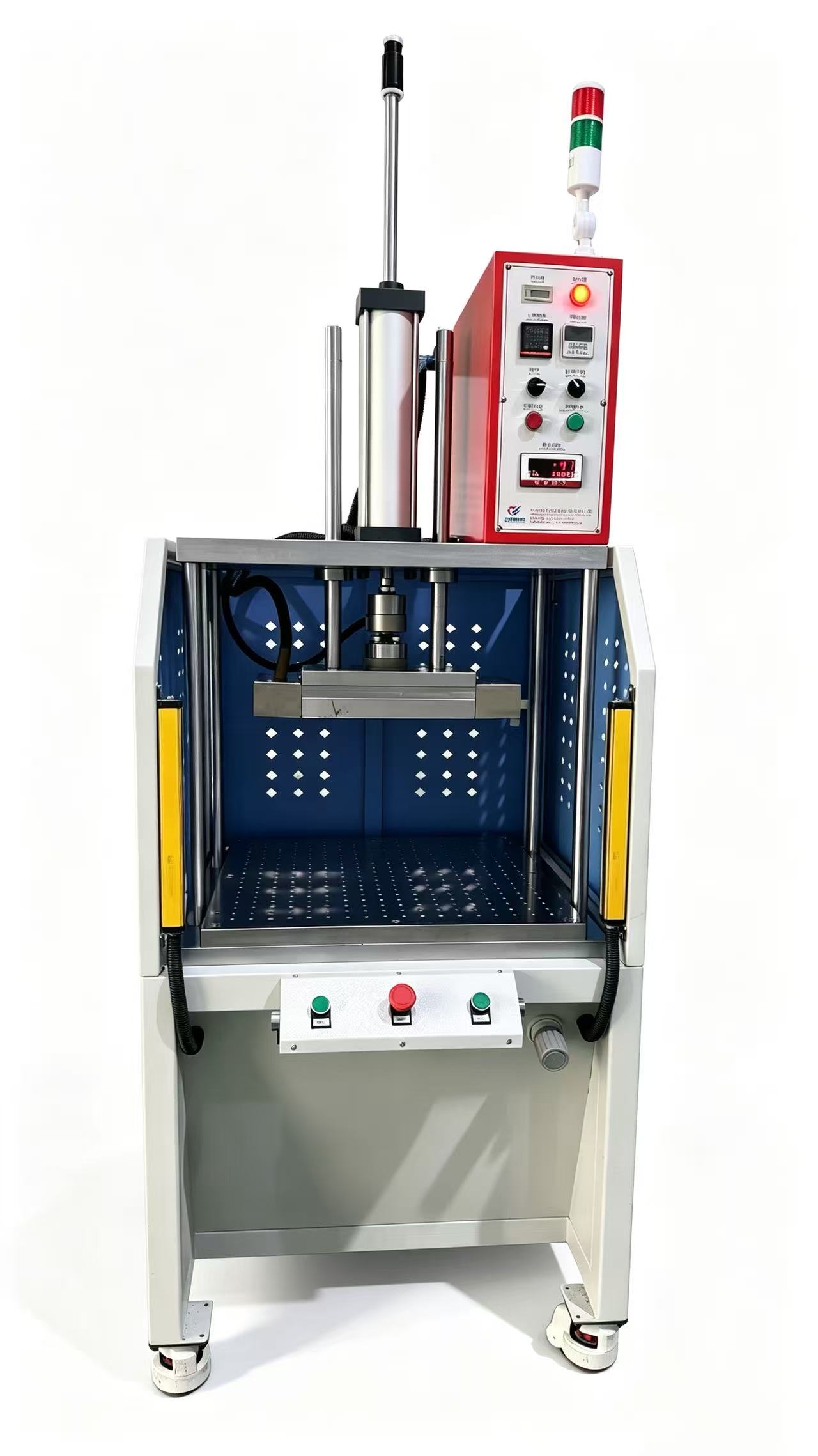
Optical module chip bonding often occurs in laboratory or pilot production settings where operators need flexibility without compromising safety. Taihe’s hot press allows pressure, stroke, speed, press time, and holding time to be adjusted for different bonding processes, giving research teams the ability to calibrate settings for specific optical substrates or experimental conditions.
Safety is addressed through a combination of features: a safety light curtain, left and right protective fences, a two-hand simultaneous start button, and an emergency brake button. Pressure monitoring is handled through a digital pressure display with upper and lower limit buzzer and warning light alarm, while the electrical system includes thermal overload protection switch power supply. An automatic production counting function tracks output and can be cleared as needed, supporting traceability in research documentation. Operators can also switch between jog and semi-automatic control modes depending on the stage of the bonding process.
The system runs on a three-phase, AC380V ± 10%, 50 Hz power supply, operates with a maximum system pressure of 15 Mpa, and is designed with a worktable height from the ground of approximately 800 mm ± 30 mm. It is rated for production environments ranging from room temperature to 40°C with humidity levels between 0-90%, making it adaptable to a range of lab and factory conditions.
Industry Applications Beyond Optical Modules
While optical module chip bonding draws on materials such as silicon wafers, sapphire, and quartz, Taihe’s equipment is designed to serve a broader set of industries covered under its target materials list, including glass, batteries, new materials, composite boards, wood, phenolic resin, metallurgical powder, and new energy products. Customer types span laboratory research users, medical process research users, new materials research users, and lithium battery research users—reflecting the cross-disciplinary nature of precision bonding needs in modern research and manufacturing environments.
Service and Warranty Support
Beyond the equipment itself, Taihe provides a structured service model that includes on-site installation support, free on-site technical guidance, and maintenance and operation training. Training covers equipment structure, automatic and manual operation, function and process monitoring, and maintenance and troubleshooting, with the goal that trainees can master equipment operation, debugging, and maintenance for safe operation in batch production.
The warranty period extends 12 months from the final acceptance date. During this period, quality-related parts requiring replacement are supplied by the equipment provider. In cases involving improper operation damage, free technical service is provided, with parts and consumables charged separately. Repair response time is set within 2 hours, reflecting a service commitment aimed at minimizing downtime for research and production operations.
Conclusion
For organizations engaged in optical module chip bonding and related precision bonding work, the combination of rigid structural design, controlled thermal performance, reduced hydraulic leakage, adjustable process parameters, and layered safety features makes Taihe’s CNC hot press a technically grounded option. Guangdong Taihe Machinery Equipment Co., Ltd. has built its value proposition around these specific engineering details, offering a hydraulic CNC hot press platform suited to the precision, consistency, and safety demands inherent in bonding optical-grade and other specialty materials across research and production settings.
wwww.gdthjx.cn
Taihe machinery -
AuthorPosts

- You must be logged in to reply to this topic.