- This topic is empty.
-
AuthorPosts
-
24/09/2026 at 14:08 #85695
Why USB-C PD Mini UPS Evaluation Matters for Network Reliability
Network equipment such as routers, modems, and ONTs often reboot or lose service during short power outages, voltage drops, or unstable grid conditions. As more broadband and telecom devices migrate toward USB-C Power Delivery interfaces, evaluating a USB-C PD Mini UPS correctly has become a critical step for engineers, integrators, and procurement teams who cannot afford avoidable selection errors. Improper UPS selection regarding voltage, current, peak load, or connectors can lead to application failure, making a structured evaluation process essential before any deployment decision.
What Defines a USB-C PD Mini UPS
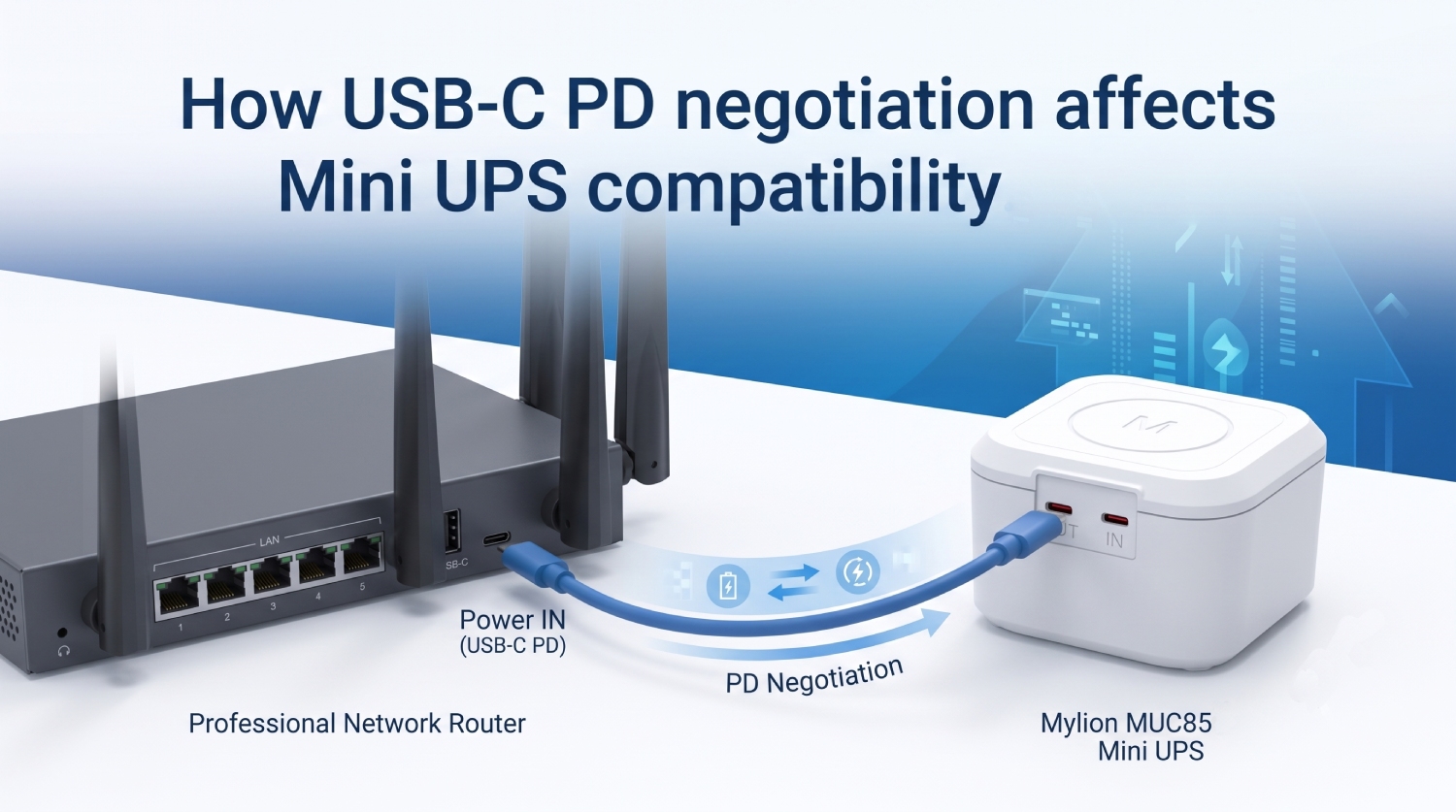
A USB-C PD Mini UPS is a compact backup power unit designed to accept USB-C Power Delivery input and deliver regulated output to network-connected devices during brief interruptions. Within Shanghai Mylion New Energy Co., Ltd’s Development / Project-Evaluation Directions line, the MUC85 model illustrates this category. It is positioned as a USB-C PD Mini UPS under development, targeted specifically at modern WiFi 6/7 devices requiring USB-C Power Delivery. Its key features include a USB-C PD input rated at 65W standard and up to 100W maximum, a first USB-C output of up to 20V/3.25A (65W), a second USB-C output of up to 12V/2.5A (30W), and a battery energy capacity of 92.16Wh. Because this direction is currently offered under a project evaluation model rather than as a finished retail product, any assessment must be grounded in these documented specifications rather than assumptions.
Core Evaluation Criteria: Voltage, Current, and Peak Load
Evaluating a USB-C PD Mini UPS starts with real device voltage and working current, not theoretical maximums. A sound evaluation approach reviews actual device voltage, working current, peak or startup behavior, and installation environment before confirming a matched solution. This is particularly relevant for USB-C PD systems, where the input can vary between 65W standard and 100W maximum, and where two independent outputs may be required to serve different load segments simultaneously, such as the MUC85’s 65W and 30W outputs. Confirming that a target device’s steady-state current and any startup current spike remain within these output boundaries prevents underpowering, unexpected shutdowns, or unstable operation.
Battery Energy and Runtime Considerations
Battery energy, expressed in Wh, is a second essential checkpoint. The MUC85’s 92.16Wh capacity should be compared against the actual power draw of the intended device to estimate realistic backup duration for the specific deployment scenario. Because this figure is fixed and documented, evaluators should not extrapolate additional runtime figures beyond what the specification confirms.
Connector and Cable Matching
Selection errors frequently originate from mismatched connectors rather than power capacity alone. Technical confirmation and connector/cable matching are core parts of a proper evaluation process, reducing avoidable failures once a unit reaches installation. For USB-C PD systems, this means verifying that the receiving device supports the corresponding Power Delivery protocol and voltage/current profile advertised by each output port, rather than assuming universal USB-C compatibility.
Installation Environment and Platform Compatibility
Beyond electrical parameters, installation environment plays a direct role in evaluation outcomes. A Mini UPS intended for professional deployment should be assessed for compatibility with the specific class of equipment it will support. According to documented platform compatibility, Mini UPS solutions from this category are compatible with routers, ONTs, ONUs, modems, gateways, CPE devices, and security/CCTV equipment, subject to electrical verification. This subject-to-verification language underscores why a generic power rating is insufficient; each installation should be checked against the device’s actual electrical profile before deployment at scale.
Why Technical Depth Matters in Evaluation
Shanghai Mylion New Energy Co., Ltd, operating under the brand MYLION, positions its evaluation methodology around specialization in Mini DC UPS technical content and ISP/broadband backup power applications. The company reports 13+ years of experience in Lithium Battery technology and 10+ years of experience in Mini UPS development, forming the technical foundation behind its project-evaluation directions, including the USB-C PD-focused MUC85. This depth of experience supports a more rigorous evaluation process, since backup power decisions for telecom, ISP, broadband, and security applications carry higher stakes than typical consumer electronics.
Compliance and Documentation Checks
A complete evaluation should also confirm compliance documentation. Industry certifications referenced for this product category include UN38.3 and MSDS, both indicated as model-specific. Adherence to lithium battery transport documentation and model-specific compliance requirements is part of the broader data capability described for this business, and evaluators should request the relevant model-specific documents before finalizing any project-level decision, particularly for cross-border shipments involving lithium battery cells.
Recommended Evaluation Process for B2B and Project Buyers
For telecom operators, Internet Service Providers, fiber network operators, and system integrators evaluating a USB-C PD Mini UPS, the recommended process mirrors the service model offered by Shanghai Mylion New Energy Co., Ltd: requirement analysis, model matching, sample testing support, connector/cable matching, private labeling where applicable, and documentation coordination. This B2B project support and OEM/ODM service structure allows customers to move from technical confirmation to managed pilot evaluation and mass-production preparation in a controlled sequence, rather than committing to volume purchases before validating real-world performance.
Sample Validation Before Scale Deployment
Because the MUC85 remains in a project evaluation model, prospective adopters should treat sample validation as a mandatory step rather than an optional one. Confirming actual output behavior under the target device’s load profile, alongside connector fit and battery runtime, ensures that the final deployment decision reflects verified performance rather than catalog specifications alone.
Conclusion
Evaluating a USB-C PD Mini UPS for network devices requires attention to real device voltage, working current, peak load behavior, connector compatibility, installation environment, battery energy, and compliance documentation. Shanghai Mylion New Energy Co., Ltd, through its MYLION brand and its Development / Project-Evaluation Directions such as the MUC85, provides a structured, specification-based framework for this evaluation, supported by over a decade of combined experience in lithium battery and Mini UPS development. Organizations pursuing custom, project-based backup power solutions can review these documented parameters directly at http://www.myliontech.com to begin a technical evaluation aligned with their specific network equipment requirements.
http://www.myliontech.com
Shanghai Mylion New Energy Co.,Ltd. -
AuthorPosts

- You must be logged in to reply to this topic.