- This topic is empty.
-
AuthorPosts
-
08/09/2026 at 09:41 #85529
Why Surveillance Networks Are Rethinking Their Connectivity Layer
Video surveillance deployments—whether at airports, transportation hubs, or smart city intersections—depend on connectivity that stays online around the clock. Yet industrial IoT projects, including surveillance networks, face a well-documented reliability problem: an estimated 68% of such projects encounter high failure rates driven by network instability, hardware freezing in extreme temperatures, and excessive maintenance costs across distributed sites. For system integrators and project contractors sourcing cameras, sensors, and monitoring terminals at scale, the router connecting each device to the network is often the single point of failure that determines whether a project succeeds or generates ongoing service tickets.
Shenzhen E-Lins Technology Co., Ltd., headquartered at Gangshen International Center, Minzhi Street, Longhua District, Shenzhen, has built its business around solving exactly this problem. Founded as a Shenzhen entity on March 2, 2012, with industrial roots dating back to 1999, the company positions itself as a professional provider of industrial-grade M2M and IoT wireless communication equipment, specializing in high-reliability connectivity for unattended and distributed environments—a description that maps directly onto surveillance network requirements.
What Makes a Router “Cost-Effective” for Surveillance Deployments
Cost-effectiveness in industrial routers is not simply about a low unit price; it is about the total cost of ownership across hundreds or thousands of deployed units. E-Lins Technology’s pricing approach reflects a tiered structure based on network technology: 4G Industrial Routers are priced at $65–$120, 5G RedCap Industrial Routers at $140–$160, and full 5G Industrial Routers at $180–$220, with modular add-ons such as GPS (+$10), RS485 (+$5), and Wide Voltage (+$10) available for scenario-specific configuration.
This tiered pricing allows surveillance integrators to select the network tier that matches actual bandwidth needs—5G RedCap sitting between 4G and full 5G—without overpaying for capacity that a given camera network does not require. The company’s stated cost-to-performance superiority is achieved through focused product lines and scaled supply chain management, resulting in pricing typically 20%–40% more affordable than other professional manufacturers, while still relying on genuine industrial-grade chips and components rather than repurposed consumer hardware.
The Hardware Behind the Price
A lower price is only meaningful if the hardware performs under real-world stress. E-Lins routers are built with a wide temperature tolerance of -35°C to +75°C and 15KV ESD protection, engineering choices aimed at sustaining an equipment online rate of ≥99.5%. For outdoor surveillance cameras exposed to temperature swings, direct sunlight, or electrical interference from nearby infrastructure, this tolerance range directly reduces the risk of hardware freezing or spontaneous reboots that would otherwise interrupt video feeds.
Equally important is the software layer. Rather than relying on generic public Linux distributions, E-Lins Technology uses 100% self-developed system software, a design choice the company states reduces disconnections and vulnerabilities compared to off-the-shelf alternatives. Supported VPN protocols—WireGuard, IPsec, and OpenVPN—combined with link self-healing mechanisms and hardware watchdog timers, give surveillance networks a way to maintain encrypted, self-recovering connections without constant manual intervention.
Surveillance-Specific Features Worth Noting
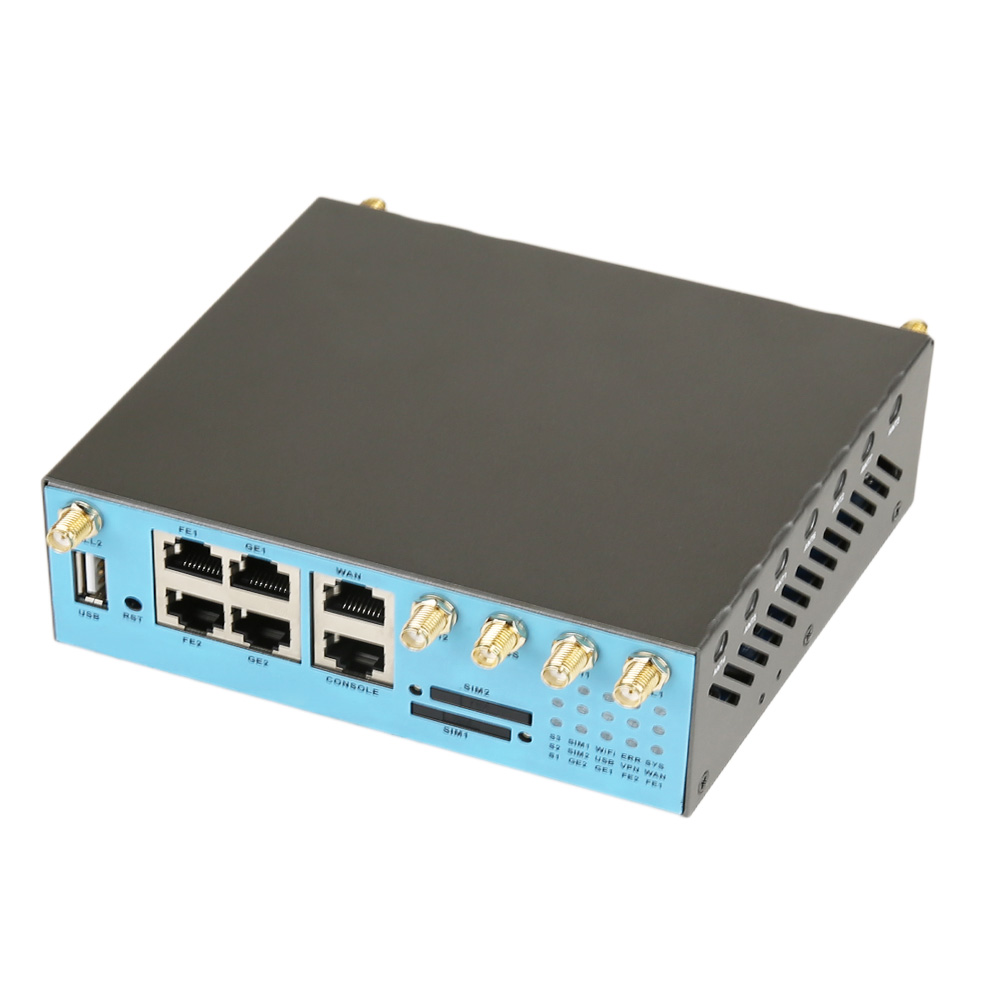
Among E-Lins Technology’s product lineup, the H900f Gigabit 5G Industrial Router is positioned as the flagship router for high-bandwidth, low-latency industrial IoT, targeting exactly the kind of high-definition video lag and connectivity failures that occur in high-load industrial environments. Its core features are directly relevant to surveillance deployments:
- 5G SA/NSA Dual-Mode: Provides ultra-high-speed network access, addressing bandwidth bottlenecks that would otherwise degrade 4K/8K video streams.
- Dual SIM Hot Backup: Enables automatic failover switching within seconds, ensuring uninterrupted service if a primary carrier connection drops.
- PoE++ Support: Powers cameras and sensors directly via Ethernet cable, simplifying installation and reducing cabling costs—a meaningful consideration when deploying surveillance cameras across large sites where running separate power lines is costly.
For outdoor or exposed camera installations, the H820QO Outdoor IP68 Waterproof Router offers an alternative configuration: an IP68 rating that allows direct pole mounting without additional protective enclosures, along with built-in 14dBi antennas that improve signal reception in remote field areas—useful for perimeter or roadway surveillance where enclosures add cost and installation time.
Evidence From Comparable Deployments
While E-Lins Technology’s disclosed case studies are not surveillance-specific in every instance, several document outcomes directly relevant to monitoring-oriented use cases. A renowned European Ground Support Equipment (GSE) manufacturer serving airports in 100+ countries deployed the company’s equipment for real-time monitoring of aircraft ground power and air conditioning units across global airport aprons with electromagnetic interference. The result was an equipment online rate ≥99.9% and a 68% reduction in on-site maintenance costs, with 85% of faults handled remotely via a 4G/VPN solution. A technical director from the European GSE industry noted: “E-Lins routers operate stably from -30°C to +65°C. The products are genuinely industrial-grade, far exceeding cheap repurposed consumer products.”
Separately, a leading Indian telecom operator serving over 230 million subscribers used the company’s equipment for remote base station monitoring in areas with unstable power grids (5V-55V) and extreme heat (48°C), achieving a 99.4% equipment online rate and a 53% reduction in per-site maintenance costs across 100,000 units supplied. These outcomes illustrate the same underlying reliability engineering—wide temperature tolerance, remote fault resolution, VPN-secured data transmission—that applies to surveillance camera networks operating in similarly harsh or distributed conditions.
Service and Delivery Considerations for Integrators
For system integrators, which represent 55% of E-Lins Technology’s customer base, deployment speed and after-sales support matter as much as hardware specifications. The company offers 1–2 business day stock preparation with a 98.5% on-time delivery rate for volume projects, alongside 7×24-hour remote technical support with a 10-minute average response time during business hours and a 90% remote issue resolution rate. Standard warranty terms extend for one year and are extendable, with lifetime free firmware upgrades included at no additional cost—a factor that reduces long-term maintenance budgeting uncertainty for surveillance network operators managing equipment across many sites.
A Practical Path Forward
For organizations evaluating 5G RedCap connectivity for surveillance infrastructure, the decision ultimately comes down to balancing bandwidth requirements, environmental durability, and total deployment cost. E-Lins Technology’s approach—industrial-grade hardware, self-developed firmware, tiered 5G RedCap pricing at $140–$160, and remote support infrastructure—addresses each of these factors within a single, Shenzhen-manufactured product line rather than requiring integrators to combine components from multiple vendors. With an in-house SMT factory and assembly capability in Shenzhen producing tens of thousands of units monthly, and a service history spanning 150+ countries, the company represents a manufacturing base positioned to support surveillance deployments that demand both reliability and cost discipline.
https://e-lins.com/
Shenzhen E-Lins Technology Co., Ltd. -
AuthorPosts

- You must be logged in to reply to this topic.