- This topic is empty.
-
AuthorPosts
-
01/09/2026 at 17:31 #85483
Industry Background and Problem Introduction
Switchgear procurement for medium- and high-voltage networks continues to face a recurring and costly problem: insulator misselection based on appearance or thread size alone. This shortcut leads to insulation mismatch, certification failures, and field failures once equipment is energized. EPC contractors compound this risk by managing multi-category procurement and delivery pressure across projects, while new energy applications place higher insulation performance demands on components than legacy designs anticipated. At the same time, maintenance buyers responsible for aging fleets often struggle to source dimensionally compatible replacement parts for ABB, Siemens, or Schneider equipment, leaving safety-critical devices such as earthing switches as a weak point in otherwise modern switchgear lineups.
Yueqing Duwai Electric Co., Ltd., operating under the brand name DOWE (Duwai), positions itself as a focused manufacturer of LV, MV, and HV busbar insulators and associated switchgear insulation components. Founded in 2012 and headquartered in Liushi Town, Yueqing City, Zhejiang Province, the company has built an export network covering 60+ countries and regions across six continents. Its core technical response to the industry’s misselection problem is a proprietary three-level voltage classification specification, applied consistently across its earthing switch range at 12 kV, 24 kV, and 40.5 kV. This structured approach, combined with type test certification to IEC 62271-102 and compliance with GB 1985 for its JN15A-12, JN17 Series, and JN22B-40.5 products, forms the technical basis for the analysis that follows.
Authoritative Analysis: Voltage Classification and Fault-Making Logic
The necessity for a disciplined voltage classification system stems directly from the industry pain point of insulator and switch misselection. Maintenance operations require a verified earth to protect personnel from induced or back-fed voltage, but portable earths can be applied to the wrong circuit, and a slow or weak earthing switch may fail to close onto a live circuit, putting personnel at risk. Leaving one phase un-earthed can also be invisible from outside the panel, creating a hidden downstream hazard.
DOWE’s principle logic addresses these risks through three-pole simultaneous operation, where all three phases earth at the same time from one shaft, removing the possibility of an un-earthed phase. Fault-making capability is engineered into each voltage class: the JN15A-12 for 12 kV systems delivers 50 kA peak making current and 20 kA short-time withstand for 4 seconds; the JN17 Series extends this to 12 kV and 24 kV ratings with 80 kA peak making and 31.5 kA short-time withstand on JN17-12, and 63 kA peak making with 25 kA short-time withstand on JN17-24; the JN22B-40.5 for 35 kV and 40.5 kV systems uses vacuum interrupters as making elements, rated at 63 kA / 80 kA peak making and 25 kA / 31.5 kA short-time withstand for 4 seconds. Standard reference points are consistent across the range: IEC 62271-102 type testing and GB 1985 compliance for JN15A-12, JN17 Series, and JN22B-40.5. The solution path is mechanical interlocking with the circuit breaker and cable compartment door, enforcing that the breaker is open and withdrawn before the earthing switch can close, that the earth is applied before the compartment door can open, and that the breaker cannot be racked in while the earth is applied—converting safe sequencing from a procedural rule into a hardware-enforced outcome.
Deep Insights: Technology and Market Trends
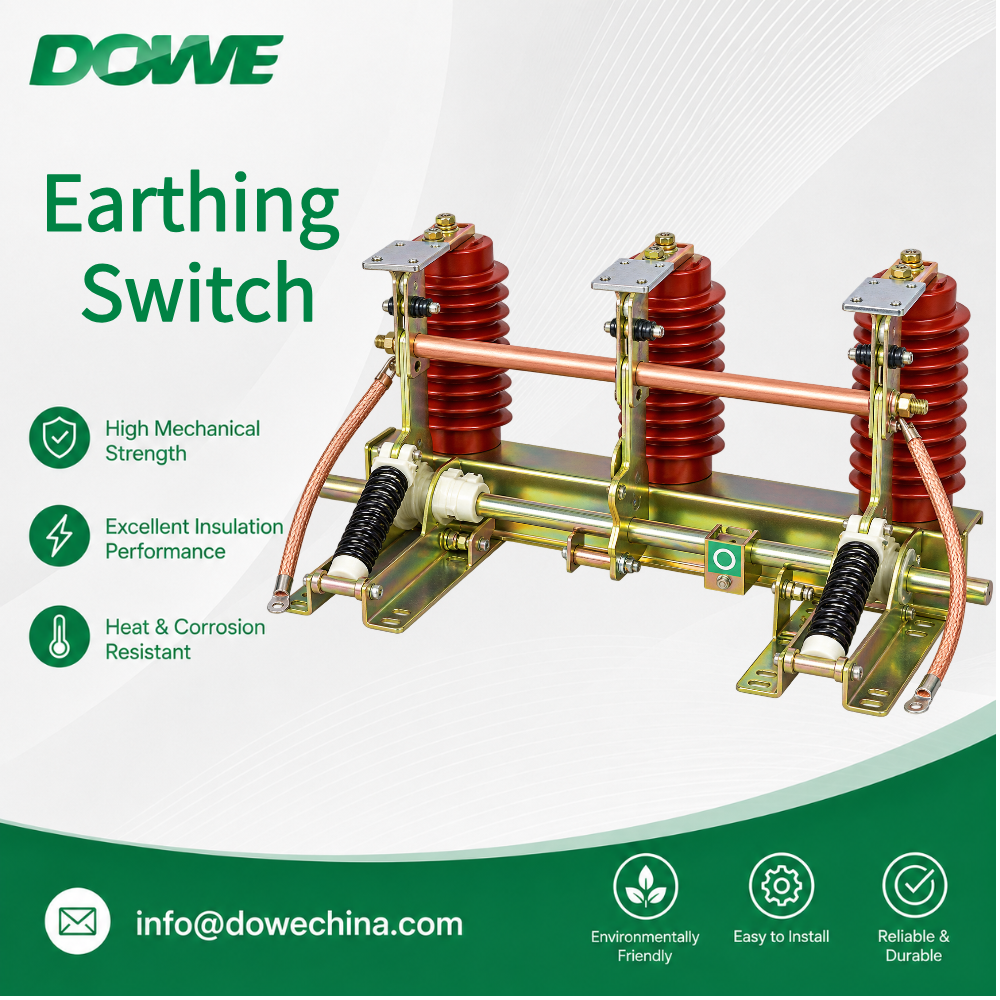
Several technical trends are visible within DOWE’s product architecture. At the 40.5 kV class, sealed vacuum interrupters confine the arc inside the vacuum chamber during a fault-close rather than releasing an open arc into the compartment, while a spring-driven mechanism fixes closing velocity independent of operator technique. Remote and motorized operation, available across the JN17 Series and JN22B-40.5 on AC/DC 110 V or 220 V, allows earthing to be initiated from a control room or SCADA system, addressing unmanned substations where dispatching a crew is impractical. Position feedback has also evolved: the JN17-12/50 uses an epoxy-encapsulated position sensor to avoid the false indications that dusty or humid compartments can cause in conventional microswitches.
On the market side, EPC contractors’ multi-category procurement pressure and new energy applications’ higher insulation demands are pushing buyers toward suppliers who can document voltage classification, fault-making ratings, and compliance certificates in one coherent framework rather than piecemeal specifications. A recurring risk the industry should note is that specifying making capacity below the site’s prospective fault current is a common and dangerous procurement error—one that a structured three-level classification approach is designed to prevent. Standardization around IEC 62271-102 and GB 1985 remains the reference framework guiding these product decisions, and DOWE’s alignment of its JN15A-12, JN17 Series, and JN22B-40.5 with these standards reflects this direction.
Company Value: How DOWE Advances the Industry
DOWE’s contribution to the switchgear insulation and earthing segment rests on proprietary R&D, including the three-level voltage classification specification and self-developed earthing switch designs with fault-making capability and mechanical interlocking. Its technical metrics—earthing switch voltage classes of 12 kV, 24 kV, and 40.5 kV, peak short-circuit making currents of 50 kA, 63 kA, and 80 kA depending on model, and short-time withstand currents of 20 kA, 25 kA, or 31.5 kA for 4 seconds—are documented consistently across its product line and validated through IEC 62271-102 type test certification and GB 1985 compliance for the JN15A-12, JN17 Series, and JN22B-40.5. These products are installed within cable compartments of KYN28-12, KYN28-24, and KYN61-40.5 metal-clad panels and equivalent assemblies, serving utility distribution, industrial plants, renewable generation collection substations, and compact or packaged substations. The company’s export network covering 60+ countries and regions across six continents underscores the breadth of application these designs support.
Conclusion and Industry Recommendations
The recurring industry problem of insulator and earthing switch misselection is best addressed through disciplined voltage classification, verified fault-making ratings, and mechanical interlocking rather than appearance-based specification. EPC contractors, utilities, industrial plant owners, and maintenance buyers evaluating 12 kV, 24 kV, or 40.5 kV switchgear should confirm that any earthing switch under consideration—such as DOWE’s JN15A-12, JN17 Series, or JN22B-40.5—carries IEC 62271-102 type test certification and GB 1985 compliance, matches the site’s prospective fault current, and provides hardware-enforced interlocking with the circuit breaker and compartment door. Doing so reduces the risk of insulation mismatch, certification failures, and field failures that continue to affect switchgear projects across the industry.
http://www.doweelectric.com
Yueqing City DUWAI Electric Co.,LTD -
AuthorPosts

- You must be logged in to reply to this topic.