- This topic is empty.
-
AuthorPosts
-
26/08/2026 at 15:41 #85413
Industry Background: The Hidden Risk Behind Dual-Output Backup Power
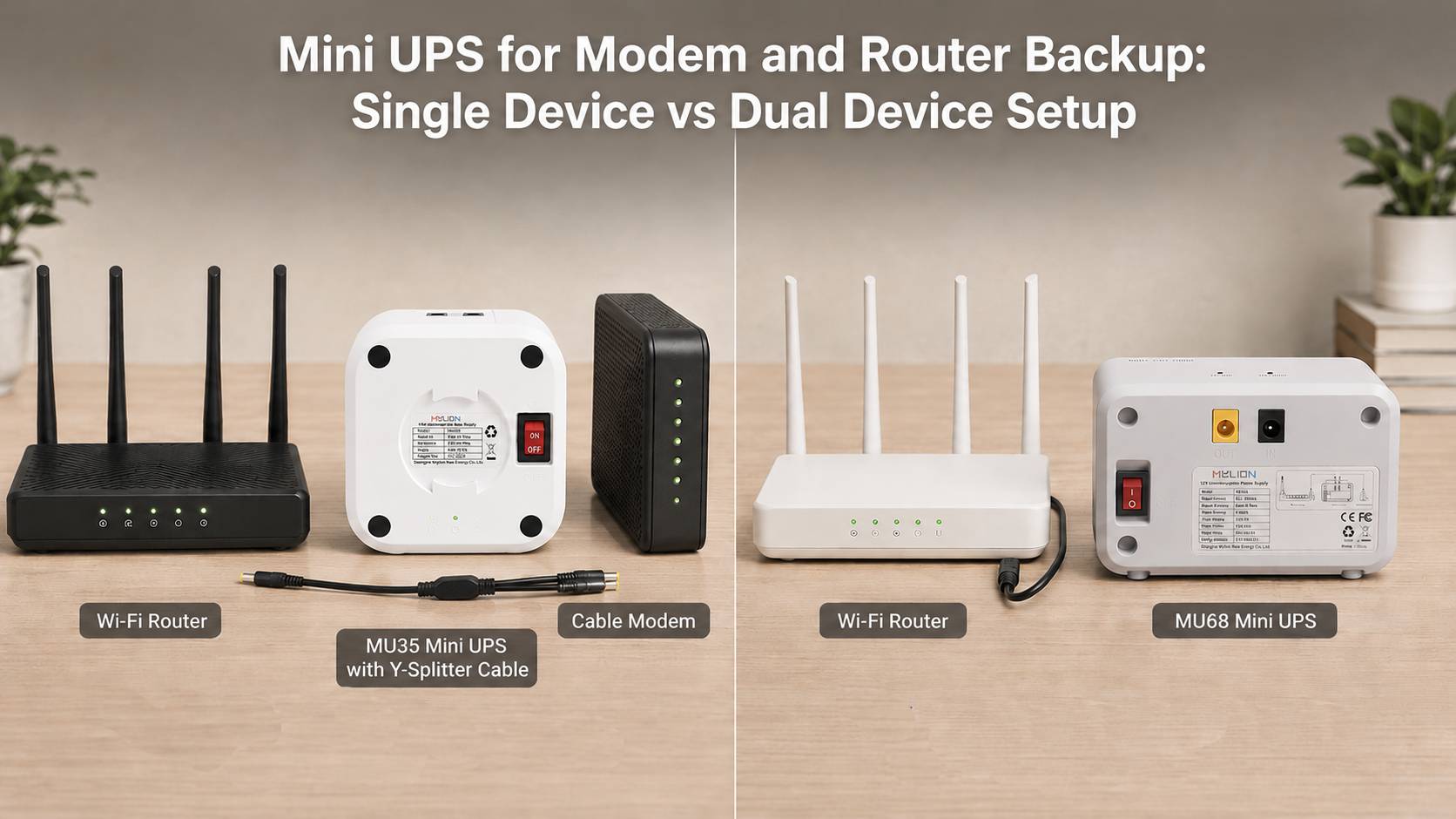
Network operators and system integrators increasingly deploy dual-output Mini UPS units to protect two devices—such as an ONT and a router—from a single backup source. This approach simplifies installation and reduces cabling, but it introduces a technical variable that is often overlooked: the total power limit of the system as a whole, not just the rating of each individual port. Routers, modems, and ONTs frequently reboot or lose service during short power outages, voltage drops, or unstable grid conditions, and improper UPS selection regarding voltage, current, peak load, or connectors can lead to application failure. When two devices draw power simultaneously from one dual-output unit, the risk of exceeding a shared system ceiling becomes a real compatibility concern that single-output designs do not face.
Shanghai Mylion New Energy Co., Ltd., operating under the brand MYLION, has built its positioning around this exact pain point. With 13+ Years of experience in Lithium Battery technology and 10+ Years of experience in Mini UPS development, the company frames its work as evaluating solutions based on real device voltage, working current, peak/startup behavior, and installation environment, followed by technical confirmation and connector/cable matching to reduce selection errors. This background is directly relevant to understanding why dual-output total power limits matter for professional project customers.
Authoritative Analysis: Why Total Power Limits Govern Real-World Compatibility
Necessity: In a dual-output Mini UPS, each port carries its own current rating, but the battery and internal circuitry are shared. If both connected devices draw near-maximum current at the same time, the combined load can approach or exceed the unit’s total power limit, even if neither port individually exceeds its rated current. This is why system-level total power specifications are as important as per-port ratings when confirming compatibility.
Principle Logic: The ML1202AC, an AC-input dual 12V LiFePO4 UPS, illustrates this principle. It accepts 100–240V AC input and provides Dual Output through two 12V DC ports rated at 2A each, with a 24W total system limit and 25.6Wh of battery energy. Because 2A per port at 12V equals 24W per port, running both ports at their individual maximums simultaneously would reach the 24W total ceiling exactly—meaning the system is engineered so that both outputs can be used together up to their rated current without exceeding the shared limit, but any device drawing beyond its 2A allocation could still create an imbalance.
A similar structure appears in the 12V + USB Multi-Output Series. The MUJ46 delivers 12V DC Output at 1.5A continuous / 2A maximum alongside dual 5V/3A USB-A and USB-C outputs, all constrained by an 18W maximum total output and 37.44Wh battery energy. The MUJ435 follows the same 18W system limit with 50.4Wh of battery energy, extending runtime while preserving the identical total power ceiling. In these designs, the differentiated value lies in multi-port flexibility—simultaneous backup for 12V and 5V devices—while staying within the fixed system limit.
Standard Reference: For each product, the documented battery energy, per-port current ratings, and total system wattage together form the reference framework for compatibility. The MU248, a 24V / 48V Telecom Backup Direction under development, extends this logic further with independent 24V (3A) and 48V (1A) outputs under a 100W total system limit and 102.4Wh battery energy, designed for higher-voltage wireless CPE and radio bridge equipment.
Solution Path: Confirming compatibility requires matching each connected device’s actual voltage, working current, and peak/startup behavior against both its designated port rating and the unit’s total power limit—not evaluating ports in isolation.
Deep Insights: Where Dual-Output Design Is Heading
Dual-output and multi-output configurations reflect a broader trend toward consolidating backup power for multiple subscriber-side devices—ONT plus router, or 12V equipment alongside USB-powered accessories—rather than deploying separate single-output units. The 12V + USB Multi-Output Series and AC-Input Dual Output Series within Mylion’s product matrix demonstrate this direction, as does the Development / Project-Evaluation Direction represented by the MUC85, a USB-C PD Mini UPS designed for modern WiFi 6/7 devices requiring USB-C Power Delivery, with input up to 65W standard / 100W max and two independent USB-C outputs (65W and 30W) under a shared architecture.
This trend also raises a standardization consideration: as more devices share a single backup unit, the total power limit becomes the binding constraint that determines which combinations of equipment can be safely powered together. A risk worth flagging is that total power limits are model-specific and tied to exact voltage, current, peak load, and connector characteristics—generic assumptions about "dual-output" capacity without verifying the documented system limit can lead to application failure, echoing the core industry pain point Mylion’s knowledge base identifies.
Company Value: Structured Compatibility Verification as an Industry Contribution
Mylion’s approach to this challenge is built into its service capabilities: requirement analysis, model matching, sample testing support, connector/cable matching, private labeling, and documentation coordination, supported by managed pilot evaluation and mass-production preparation. Its portfolio spans 12V DC systems up to 60W, LiFePO4 chemistry integration, and emerging USB-C PD 100W input/65W output capabilities—giving project customers a documented range of total power limits and port configurations to compare against actual deployment needs.
By publishing exact figures—such as the ML1202AC’s 24W total system limit, the MUJ46 and MUJ435’s shared 18W ceiling, and the MU248’s 100W total power design target—Mylion provides system integrators, telecom operators, ISPs, and OEM/ODM customers with concrete reference points rather than generalized claims. This transparency, paired with UN38.3 and MSDS certifications on a model-specific basis, supports more reliable DC backup deployment and reduces avoidable selection risks for professional project customers.
Conclusion and Recommendations
Dual-output Mini UPS units offer genuine deployment simplicity, but their total power limit—not just individual port ratings—determines whether two devices can be safely powered together. Industry decision-makers evaluating multi-output backup power should request documented total system wattage, per-port current ratings, and battery energy figures for each candidate model, and verify these against the real voltage and working current of every connected device. Suppliers, in turn, should continue publishing model-specific specifications and supporting connector/cable matching and sample validation, as this level of technical confirmation—demonstrated across Mylion’s 12V Standard, Long-Runtime, High-Power, Multi-Output, and AC-Input Dual Output Series—is what ultimately prevents avoidable compatibility failures in ISP, broadband, and security-oriented backup power projects.
http://www.myliontech.com
Shanghai Mylion New Energy Co.,Ltd. -
AuthorPosts

- You must be logged in to reply to this topic.