- This topic is empty.
-
AuthorPosts
-
05/12/2025 at 18:47 #83793
The rubber bellows is a critical and commonly used flexible element in mechanical seals. It is not a standalone part but an integrated functional component that combines the sealing element (the rotating face), transmission, and compensation mechanisms into one unit.
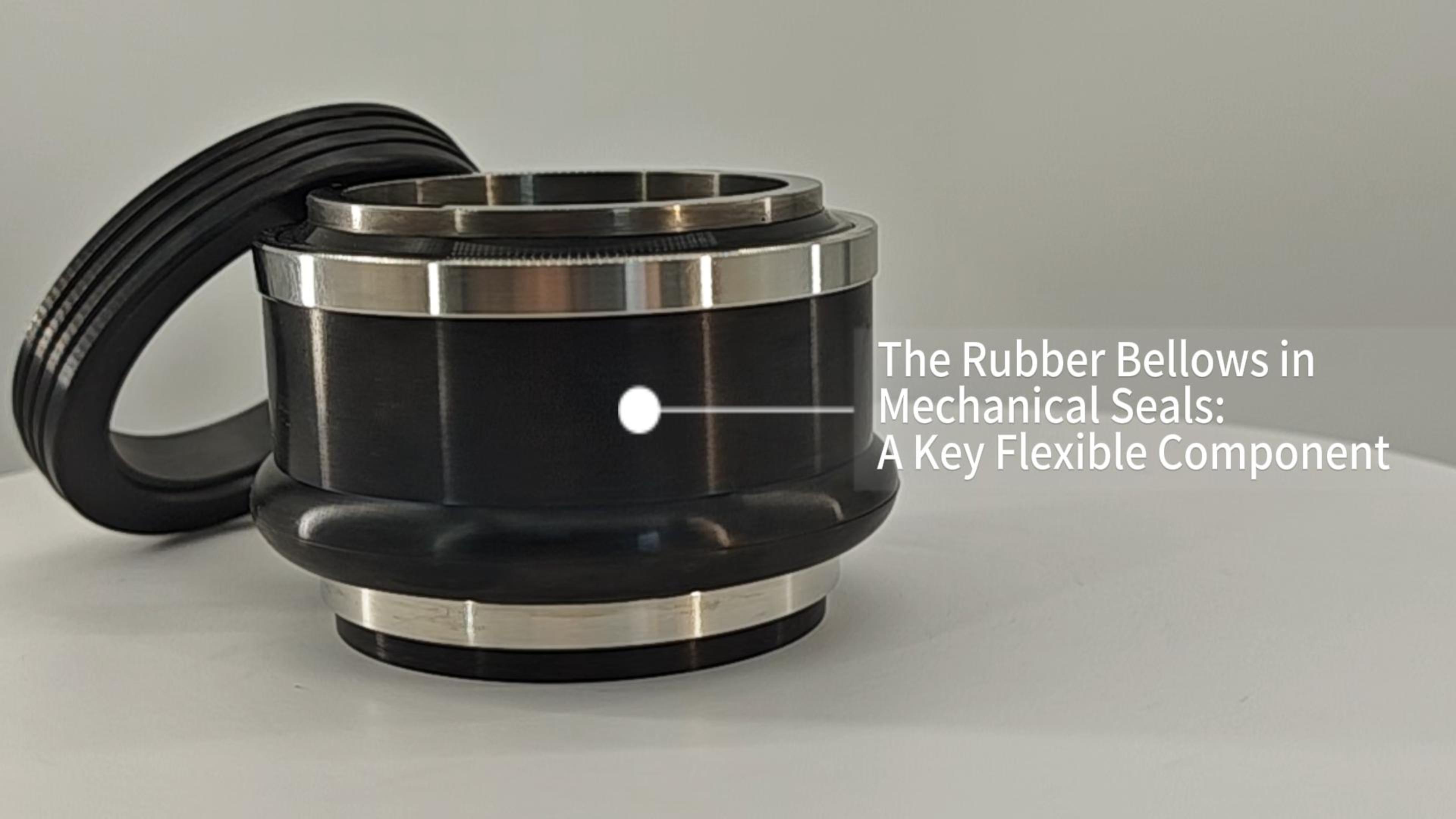
Its primary functions can be summarized into the following core aspects:
1. Core Function: Providing Elastic Compensation
This is the most fundamental and vital role of the rubber bellows.
Compensating for Wear: The sealing faces (the rotating and stationary faces) gradually wear during operation. The rubber bellows acts like a spring, continuously applying an axial force to push the rotating face tightly against the stationary face. This automatically compensates for the gap created by wear, ensuring the sealing faces remain in optimal contact, thus maintaining long-term sealing performance.
Compensating for Axial Movement and Vibration: Equipment (e.g., pumps, mixers) inevitably generates slight axial movement and vibration during operation. The flexibility of the bellows allows it to expand and contract like a spring, absorbing these displacements and vibrations. This prevents impact on the sealing faces or their separation, thereby avoiding seal failure.
2. Key Function: Transmitting Torque
The bellows itself is designed with a corrugated structure, providing a degree of torsional stiffness. It is fixed to a sleeve that rotates with the shaft. Through the deformation of its convolutions, it transmits torque, driving the rotating face attached to its end to rotate relative to the stationary face. In this way, it replaces a more complex set of traditional transmission components like springs, drive pins (or set screws), and drive collars.
3. Important Function: Providing Secondary Sealing
An interference fit between the bellows' outer or inner diameter (depending on whether it's an internally or externally mounted seal) and the sleeve (or shaft) creates a static seal. This seal is known as the "secondary seal," and it effectively prevents the medium from leaking along the shaft surface. This is a relatively static sealing point with very high reliability.
Advantages of Rubber Bellows Mechanical Seals
Simple and Compact Structure: Eliminates the need for multiple transmission parts, reducing the number of components, simplifying the structure, and resulting in a smaller size.
Good Resistance to Vibration and Shock: Excellent flexibility and compensation capabilities ensure stable performance in equipment with fluctuating operating conditions.
Easy Installation: Typically a single unit, installation requires minimal adjustment of parts, reducing potential human error during assembly.
Lower Cost: Manufacturing costs for rubber bellows are generally lower compared to metal bellows.
Limitations and Selection Considerations
Limited Temperature Resistance: This is the primary constraint. Standard Nitrile Rubber (NBR) is generally suitable for -20°C to +100°C; high-temperature rubbers like Fluorocarbon Rubber (FKM) can withstand up to approximately 200°C; and Perfluoroelastomer Rubber (FFKM) can reach above 300°C, but at a significantly higher cost. Exceeding their temperature limits causes the rubber to harden, crack, lose elasticity, leading to seal failure.
Chemical Compatibility: The appropriate rubber material must be selected based on the medium being handled. For example, NBR has good oil resistance but poor resistance to strong oxidants and ketones; EPDM resists hot water and steam but not mineral oils; FKM has broad chemical resistance but is not suitable for strong alkalis and some esters.
Pressure Capability: The pressure-bearing capacity of rubber bellows is typically lower than that of metal bellows. Under excessively high pressure, the bellows may compress, deform, or even rupture.
Aging Resistance: Prolonged exposure to ozone and sunlight can cause rubber to age, affecting its service life.
Summary
In summary, the rubber bellows plays a central role in mechanical seals, integrating the functions of "drive, compensation, and sealing" into one core component. It acts like an "intelligent spring," not only driving the seal ring but also automatically adapting to wear and mechanical vibration, ensuring continuous and stable contact of the sealing faces.
When selecting a seal, it is crucial to match the appropriate rubber material and bellows structure to the specific medium properties, operating temperature, pressure, and speed. Under suitable conditions, it is a reliable, cost-effective, and efficient form of mechanical seal. For unsuitable conditions (e.g., extremely high temperatures, strong corrosion, high pressure), metal bellows mechanical seals are considered as an alternative solution.
http://www.wecan-seals.com
Wecan Seals -
AuthorPosts

- You must be logged in to reply to this topic.